

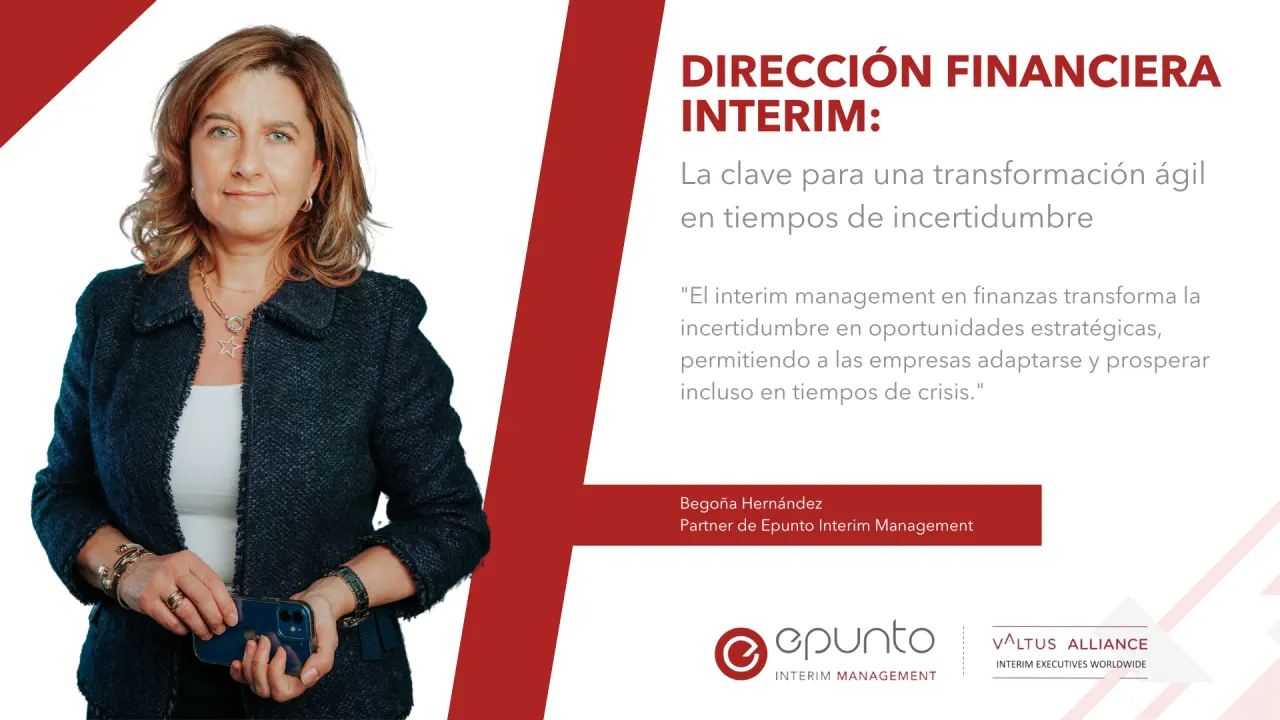
Interim Financial Management: The key to agile transformation in times of uncertainty
In an economic and business environment characterised by volatility, uncertainty, the accelerating transformation of business models and increasing digitalisation, interim finance management is emerging as a strategic tool for tackling critical challenges. More and more companies are turning to interim managers in the finance department to implement or improve […]
In an economic and business environment characterised by volatility, uncertainty, the accelerating transformation of business models and increasing digitalisation, interim financial management stands as a strategic tool for tackling critical challenges. More and more companies are turning to interim managers in the finance department to implement or improve financial processes, manage restructuring, lead change processes or optimise resources without compromising long-term stability.
The current context: developments in the global market and economic tensions have generated a growing demand for flexible financial management. Interim CFOs and finance directors have become key players, acting as strategic partners to business units to implement processes, cost-cutting measures, debt restructuring, working capital optimisation… and, in an innovative way linked to the digitalisation inherent in the finance function, to drive competitiveness and growth by supporting diversification, the development of new business models, data management and advanced data analysis, or tools – still emerging – such as Artificial Intelligence.
This form of interim financial management enables companies to draw on experts who provide an external, neutral and highly specialised perspective during these times of profound transformation.
‘Interim financial management not only offers a temporary solution, but also acts as a strategic catalyst that enables companies to tackle uncertainty and achieve sustainable transformation.’
Benefits of interim financial management
- Agility and speed: Bringing in an interim professional enables financial problems to be resolved within very short timeframes, adapting to emerging needs without lengthy recruitment processes.
- Proven experience: These leaders have extensive track records and have managed multiple crises and transformations, enabling them to identify opportunities for improvement quickly.
- Cost-effectiveness: By opting for an interim role, companies avoid the costs associated with permanent recruitment, optimising resources whilst ensuring high-quality financial management.
- Results-oriented approach: Interim financial management focuses on achieving specific KPIs, ensuring that strategic decisions translate into measurable and sustainable results.
- External and neutral perspective: An interim professional can identify risks and opportunities that often go unnoticed by internal teams, facilitating effective restructuring and the alignment of objectives at a corporate level.
Outlook for 2025 and beyond Experience gained in international markets has shown that interim finance management is not merely a temporary solution, but a strategic investment to transform a company’s financial management. Spanish companies, in particular, are increasingly adopting this model to tackle uncertainty, drive digitalisation and respond to the demands of an ever-changing global market.
Conclusion Interim financial management has established itself as an essential tool for leading transformation in times of crisis. At EPUNTO Interim Management, in collaboration with Valtus Alliance, we are committed to flexible and specialised solutions that enable organisations to tackle financial and strategic challenges with agility and effectiveness. Put your trust in an approach that combines global experience and strategic vision to prepare your company for the future.
Partner at EPUNTO Interim Management