
The CFO of 2026: from guardian of the books to strategy co-pilot
If there is one area within the company that is undergoing a genuine silent revolution, it is the finance function. For decades, the Chief Financial Officer (CFO) has operated under a traditional model focused on auditing and reporting, acting as a su
If there is one area within a company that is undergoing a genuine silent revolution, it is the finance function. For decades, the Chief Financial Officer (CFO) has operated under a traditional model focused on auditing and reporting, acting as a sort of ‘guardian of the figures’. However, the current complexity of the market means that 20th-century tools are no longer adequate for tackling today’s challenges.
From reactive to forward-looking finance
The traditional financial model has become obsolete due to the coexistence of disconnected systems and highly manual processes, which often result in decision-making with limited visibility. A comprehensive change in model is therefore required, going beyond simply adding new technologies to old processes.
“The true value of a finance director today lies in the use of predictive data to guide strategy and growth” – Begoña Hernández, partner at EPUNTO Interim Management
In this context, Begoña Hernández, partner at EPUNTO Interim Management, highlights the urgency of evolving the role to support the company’s vision for the future: “The finance director can no longer limit themselves solely to monitoring budgets and explaining what happened in the past. Today, their true value lies in using predictive data to guide growth, anticipate risk scenarios and become the driving force behind business innovation.”
This approach requires the CFO to stop looking backwards. Previously, this role was confined to reporting; now, their primary mission is to generate real-time insights to directly and proactively influence the company’s strategy.
‘Intelligent Finance’: the new hub of business activity
The business ecosystem is witnessing the emergence of what is known as ‘Intelligent Finance’. In this scenario, finance ceases to be an isolated department or a bureaucratic bottleneck and becomes a cornerstone of the organisation’s entire activity.
This new paradigm is underpinned by three fundamental changes:
- Artificial intelligence as an operating system: It automates operational execution and significantly enhances data analysis capabilities.
- Cross-functional integration: Finance plays an active role in decisions regarding pricing, capital allocation, risk mitigation and commercial strategy.
- Organisational evolution: Fewer people will be carrying out manual tasks, but the finance function will have a much greater impact on the overall direction of the business.
The talent challenge and the rise of the ‘fractional CFO’ model
Despite the need for this change, there is an ‘uncomfortable reality’ to consider in the market: many SMEs and growth-stage companies are not prepared to tackle this transition. In their day-to-day operations, they face a lack of reliable data, struggle with outdated IT systems and suffer from a shortage of hybrid talent capable of understanding the intersection between finance, business and technology.
What is a ‘Fractional CFO’?
Added to this is the fact that not all organisations have the financial capacity to attract and recruit a strategic CFO of this calibre on a full-time basis. It is in this market gap that the fractional or part-time CFO model emerges as the most agile and efficient solution.
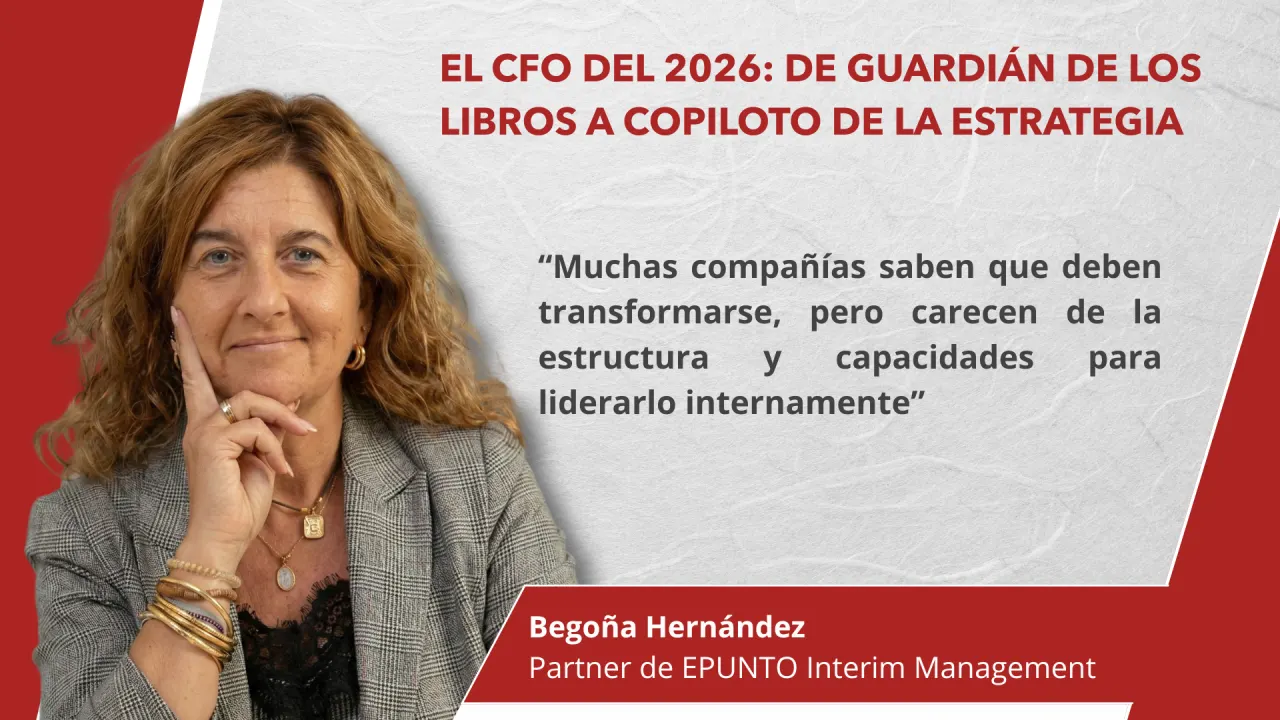
“Many companies know they need to transform, but lack the structure and capabilities to lead this change internally” – Begoña Hernández, partner at EPUNTO Interim Management
As Begoña Hernández explains, “many companies in a growth phase face a barrier: they know they need to transform, but lack the structure to lead this change internally”. In light of this, the fractional CFO model democratises access to high-level financial strategy. “We act as a catalyst: we provide the transformative leadership needed to make the leap to the new model without weighing down the company’s cost structure,” says Hernández.
The finance function is no longer about numbers, but about decisions. The CFO of 2026 must master advanced analytics, be fully integrated into day-to-day operations and champion a data-driven culture. Those organisations that understand this structural shift and invest in new talent in good time will gain a decisive competitive advantage.
At EPUNTO Interim Management, a Valtus Alliance member , we support organisations through this process of strategic evolution with flexible solutions such as The LIQUID finance . If you wish to transform your company’s finance function into a genuine driver of value and growth, contact our specialists and discover how to accelerate your transformation without adopting rigid structures.