
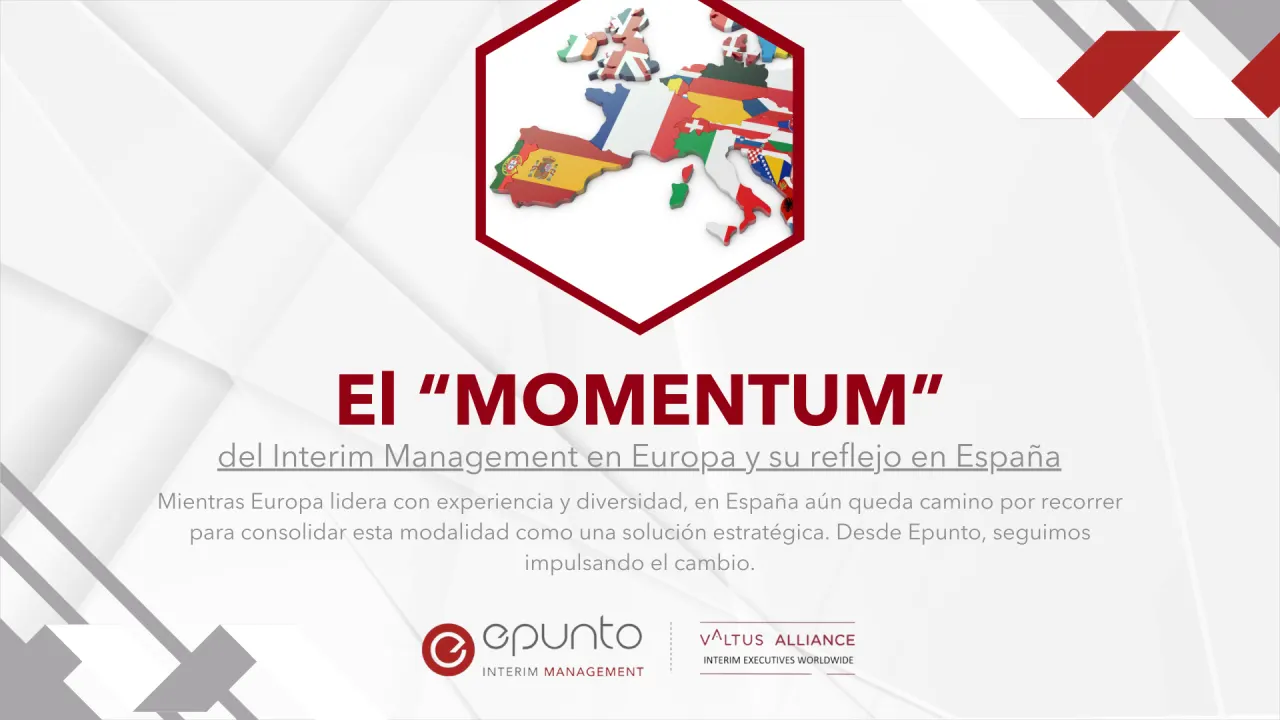
The ‘momentum’ of interim management in Europe and how it is reflected in Spain
Let’s think of interim management as a Swiss Army knife. Useful, versatile and capable of adapting to a variety of situations. Whilst a basic pocket knife has one or two blades, a Swiss Army knife can include everything from a corkscrew to a wood saw. That versatility and flexibility is precisely what modern organisations are looking for when […]
Let’s think of interim management as a Swiss Army knife. Useful, versatile and capable of adapting to a variety of situations. Whilst a basic pocket knife has one or two blades, a Swiss Army knife can include everything from a corkscrew to a wood saw. That versatility and flexibility is precisely what modern organisations are looking for when recruiting management talent.
In today’s business environment, permanent employment (traditional, full-time, etc.) is no longer sufficient or sustainable. The acceleration of technological innovation, the adoption of hybrid and remote working, and the need for specialisation in key areas such as artificial intelligence have transformed the employment landscape. According to recent data from Fiverr, over 80 per cent of companies view freelancers as an essential source of talent. This underlines the need for ‘skills on demand’, available exactly when they are needed.
Within this ecosystem, interim management has emerged as a key strategic tool for tackling business challenges. As part of the Valtus Alliance, here at EPUNTO Interim Management in Spain we have witnessed significant growth in this model, which is now positioned as a vital resource for businesses of all sizes.
The Interim Management Market in Europe
The latest results from the annual survey by INIMA (The International Network of Interim Manager Associations) shed light on the current state of interim management in Europe. With the collaboration of member organisations such as Réseau alumni AE-CMT | Anciens Elèves du Certificat de Management de Transition de Dauphine | IFMT in France, DDIM e.V. – Dachgesellschaft Deutsches Interim Management in Germany, AIM | Associação Interim Management Portugal in Portugal, and Asociación Interim Management España (AIME) in Spain, amongst others, key trends have been identified:
- Profile of the European interim manager: The average professional is a man aged between 50 and 60, with between 5 and 12 years’ experience in this field. Spain, whilst still a developing market with an average of 5.2 years’ experience, is rapidly gaining ground compared with mature markets such as Switzerland (12.4 years) and the United Kingdom (11.4 years).
- Increase in female participation: Although women represent a growing segment, their presence remains low in Europe (14 per cent on average). Poland (30 per cent), France (20 per cent) and the United Kingdom (20 per cent) lead this trend, whilst Spain ranks at the bottom of the table with 5 per cent. This highlights the need for more inclusive policies and a concerted effort to promote diversity in interim roles – something we at Epunto value deeply.
- High utilisation of interim managers: In 2024, the average utilisation of European interim managers reached 69 per cent, with countries such as Italy (85 per cent) and Switzerland (70 per cent) standing out. Spain, at 54 per cent, still has significant room for growth. This figure reflects not only the average size of our companies – the majority of which are family-run – but also the growing confidence in interim management as a solution for tackling complex challenges.
Spain: An evolving market
In Spain, interim management is proving to be an essential solution for small and medium-sized enterprises seeking to adapt to a dynamic economic environment. Part-time engagement, which is more common in markets such as Spain (38 per cent), enables organisations to access highly qualified experts without bearing the full cost of a full-time appointment.
At EPUNTO Interim Management, as the managers responsible for Spain and Portugal within Valtus Alliance, we have worked to make this model accessible to companies needing to tackle critical processes: restructuring, digitalisation or international expansion. Our commitment is to demonstrate the added value of an agile and flexible approach in a market that increasingly demands specialisation.
Sectors and roles in highest demand
Interim management is particularly relevant in sectors such as manufacturing, IT, the automotive industry and healthcare. In terms of roles, there is a high proportion of executive positions: 60 per cent of interim roles in Europe are at management level, and Spain is no exception. This figure highlights the ability of interim managers to lead based on their experience and to add value from day one.
Final thoughts
Interim management is establishing itself as a key tool for European companies seeking to adapt to a changing and competitive environment. In Spain, although progress has been notable, the statistical differences compared with the rest of Europe are significant:
- Whilst countries such as Switzerland and the United Kingdom have established markets with an average of over a decade’s experience in interim management, Spain barely reaches 5.2 years.
- The use of interim managers in Spain (54 per cent) is considerably lower than in countries such as Italy (85 per cent) or Germany (70 per cent).
- The low proportion of women (5 per cent) in the Spanish interim management market contrasts with the 20–30 per cent seen in more advanced markets.
These figures reflect the enormous potential of interim management in Spain, but they also highlight the ground that still needs to be covered. At EPUNTO Interim Management, in collaboration with the Valtus Alliance network, we remain committed to leading this change, offering innovative, high-quality solutions that drive the growth and competitiveness of Spanish companies.
Interim management is not just a tool for the present; it is a strategic investment in building the future of the business landscape in Spain and Europe.
Sources: Data taken from the INIMA annual report, updated as at the end of 2024.