

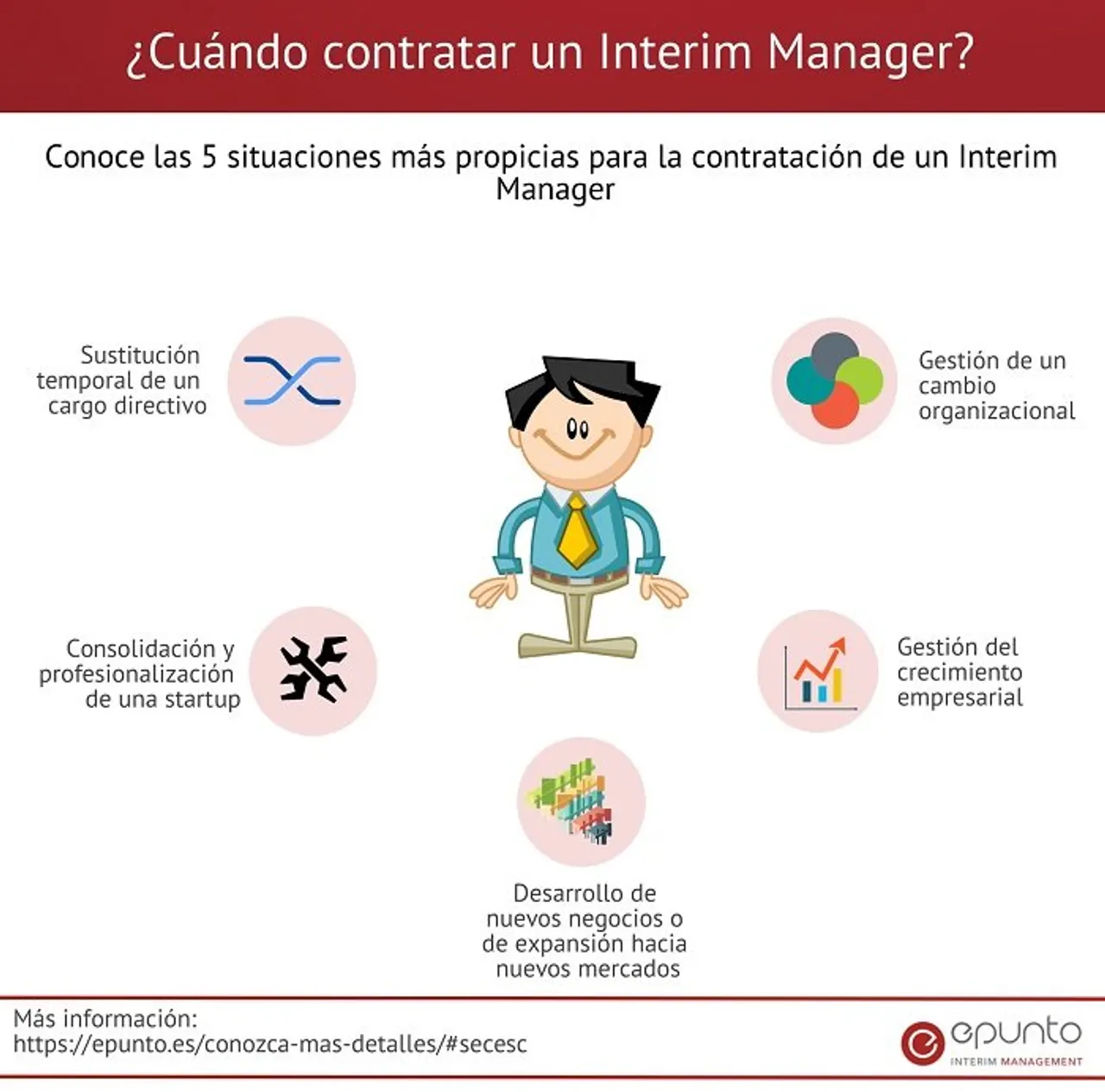
When should you hire an interim executive?
An Interim Manager is a professional with proven experience in one or more professional disciplines, hired by companies for a fixed period to carry out a specific task. This form of employment is becoming increasingly common, as Interim Managers bring their experience, knowledge and a […]
An Interim Manager is a professional with proven experience in one or more professional disciplines, hired by companies for a fixed period of time to carry out a specific task.
This form of employment is becoming increasingly common, as interim managers bring their experience, knowledge and a fresh perspective to critical situations, providing support to organisations facing challenges.
There are many advantages to hiring a temporary executive, which you can read more about in this article: Interim management: what is its value proposition?
In this article, however, we aim to explain the situations most suited to hiring an interim manager, so that you can quickly identify whether your company needs to make use of this option to enhance its current value proposition.
The five most common scenarios in which an interim manager is needed are:
Temporary replacement of an executive role
Interim managers are highly experienced executives with the ability to take charge of a management role immediately. Furthermore, they are equipped to manage transitions without disrupting the company’s normal operations. Generally, this type of scenario arises due to:
– Dismissal or resignation – Temporary absence – The period until a permanent appointment is made.
Managing a major organisational change
A key skill of interim managers is the ability to manage organisational change. By the very nature of their role, interim managers are equipped to handle change processes seamlessly, ensuring the company’s normal operations remain unaffected. The most common scenarios for organisational change today are:
– Intervention following due diligence for an acquisition or merger – Restructuring of areas, departments or business units – Professionalisation of the family board – Preparation for (generational) succession – Managing the mergers and acquisitions of a new company – Implementing cost-cutting plans – Introducing a new production line – Managing digital transformation strategies.
Development of new businesses or expansion into new markets
The interim executive possesses the necessary experience to identify and capitalise on new opportunities, create demand and design partnership strategies geared towards the evolution of companies, enabling them to keep pace with the markets and even outpace them. The scenarios within the context of business development are:
– Entry into international markets – Drawing up and implementing strategic plans – Developing new business models – Developing new market niches – Launching new product or service lines.
Consolidation and professionalisation of a start-up
Interim executives assist start-ups with pilot projects and spin-offs during their maturation phases. In this context, the interim executive acts as a start-up adviser, assisting them through the various stages of launching their business – from conceiving the idea and reviewing the business model, to developing the business plan, securing funding, and finally developing the minimum viable product and establishing market positioning.
Managing business growth
When it comes to managing strategies and projects for business growth, the Interim Manager can act as the right-hand person to company directors, providing an external perspective and the know-how gained through experience gained whilst working across multiple companies and projects.
Companies often find themselves in one of these five scenarios and continue to carry out processes as usual, without realising that they need to take immediate action to bring about change. At other times, they know that change is necessary but do not have professionals within their workforce who can successfully manage the transformation. This is where Interim Managers come in: temporary executives with the experience to overcome challenges, hired for a specific objective, capable of managing transitions without disrupting the current workforce or the company’s normal operations.