
AI and energy efficiency: the combination set to redefine industrial competitiveness over the next decade
The rapid adoption of new technologies is transforming the business landscape at an unprecedented rate. However, behind the technological revolution we are experiencing lies a structural challenge that can no longer be ignored: energy consumption. In this c
The rapid adoption of new technologies is transforming the business landscape at an unprecedented pace. However, behind the technological revolution we are experiencing lies a structural challenge that can no longer be ignored: energy consumption.
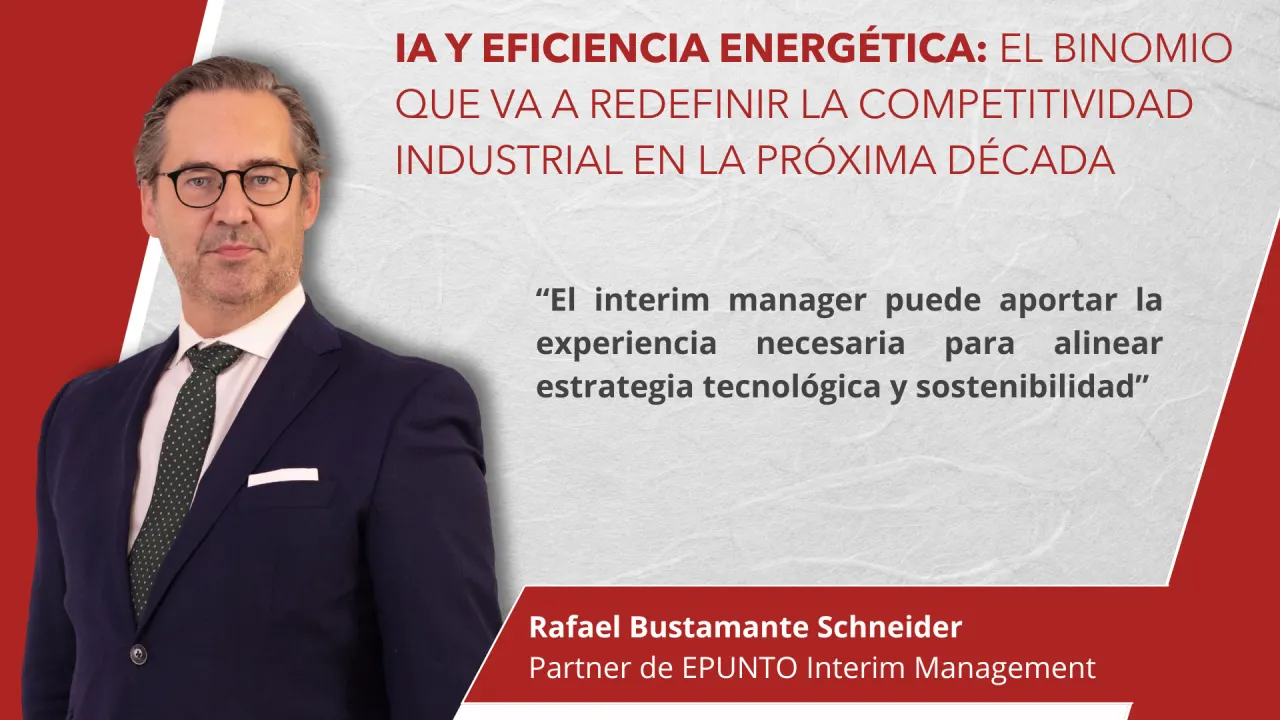
In this context, Rafael Bustamante Schneider, a partner at EPUNTO Interim Management, points out that “against the current backdrop of the boom in artificial intelligence, there is a paradox: AI drives up energy consumption, yet at the same time, it is key to optimising this and other resources. Therefore, whoever masters this duality will have a significant competitive advantage”.
Why is it urgent to act now?
The training and deployment of generative AI require computing power that is fuelling the expansion of data centres and their electricity consumption. This puts a strain on electricity grids designed for predictable and linear demand; furthermore, it creates a ‘perfect storm’ when combined with the intermittency of renewable energy sources and a context in which energy is becoming increasingly expensive.
AI as a driver of industrial efficiency
Paradoxically, artificial intelligence is also the most powerful tool for managing this demand. It transforms data into real-time cost-saving decisions through:
- Optimisation of industrial processes: AI can adjust machinery to operate within the most energy-efficient ranges or schedule high-consumption tasks during the electricity grid’s ‘off-peak hours’, thereby significantly reducing costs.
- Smart demand management (Smart Grids): Predictive algorithms are available that can anticipate the energy needs of an industrial plant based on historical patterns, weather and production volume; in this way, they are able to dynamically adjust energy procurement and usage.
- Predictive maintenance: Detecting inefficiencies in motors, compressors or air-conditioning systems before they lead to breakdowns prevents energy wastage caused by equipment operating below its optimal performance.
Recommended by LinkedIn
AI: a cornerstone of sustainability Elías Cedillo 1 year ago AI Drives Demand and Accelerates Innovation… Julio Lopez 1 month ago Using AI to improve energy efficiency? Luce Innovative Technologies 1 year agoSectors with the greatest impact
Mastering the AI-energy nexus has a direct impact on the bottom line and regulatory compliance. Although this is a cross-cutting challenge, certain sectors will undergo a more radical transformation:
- Manufacturing and Data Centres: This enables profit margins to be protected in environments where energy costs or server cooling are critical factors.
- Logistics and energy (utilities): This is vital for optimising routes for electric vehicle fleets and for energy suppliers to balance renewable supply with actual demand.
The strategic role of interim management in the technological transition
Bridging the gap between the world of data and engineering requires a rare form of cross-functional leadership. Faced with a shortage of in-house talent, interim managers make a real difference by leading teams where AI specialists and operations managers coordinate efficiently.
“The interim manager can provide the necessary expertise to align technology strategy with sustainability” – Rafael Bustamante Schneider
“Companies need leaders capable of making sense of this enormous complexity,” emphasises Rafael Bustamante. In this context, “an interim manager brings the necessary leadership experience to align technology strategy with sustainability, orchestrating talent and delivering solutions from day one without the traditional learning curve”.
At EPUNTO Interim Management, we connect your company with interim executives capable of successfully driving this process and ensuring immediate results. Contact us today and discover how we can help you accelerate this transformation.