Managing the Unmanageable: Interim Management as a shield against volatility and uncertainty.
Interim Management as a shield against volatility and uncertainty In the complex landscape we find ourselves in this year, 2026, the global geopolitical and economic landscape is under strain not seen in decades. The escalation of hostilities between Iran and the coalition led by the US and Israel places […]
In the complex landscape we find ourselves in here in 2026, the global geopolitical and economic landscape is under strain not seen for decades. The escalating conflict between Iran and the coalition led by the US and Israel is placing businesses across every continent in a state of perpetual ‘black swan’ uncertainty.
With the Strait of Hormuz under constant threat, the flow of energy supplies cut off, the price of a barrel of crude oil reaching $100 and once again challenging stability, and inflation once more threatening businesses and consumers, the rules of corporate management demand a thorough review.
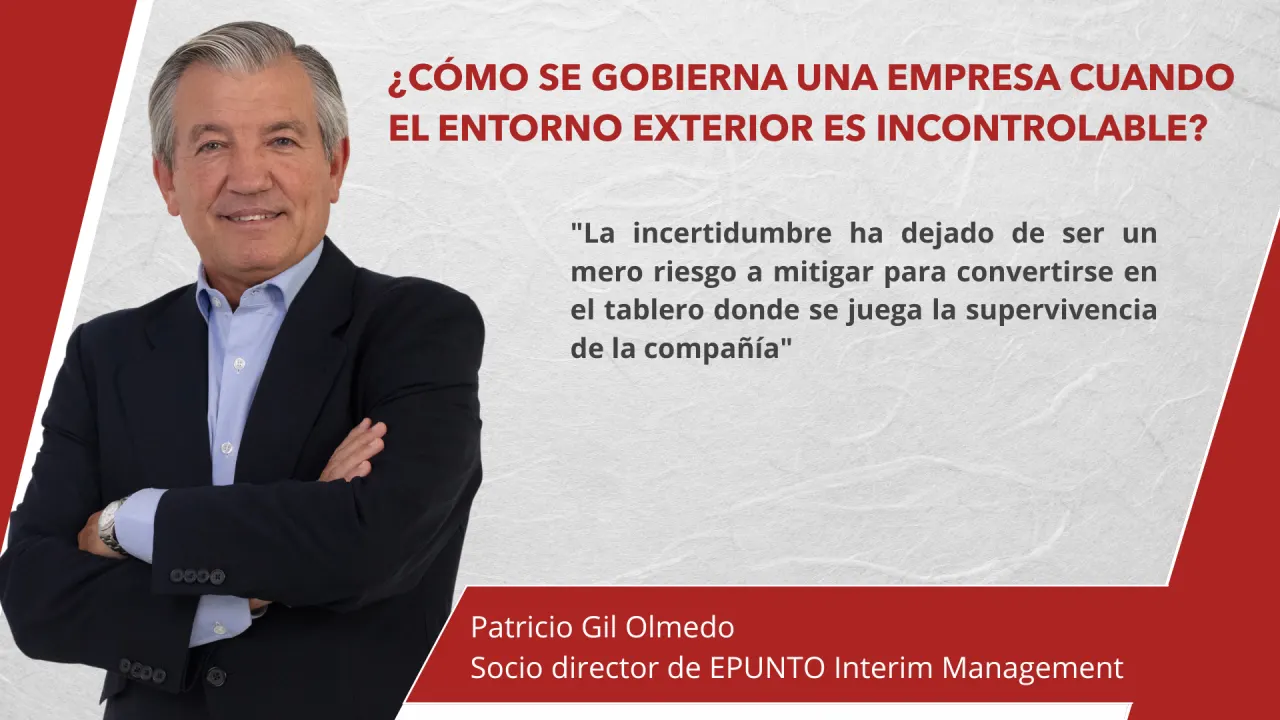
“Uncertainty is no longer merely a risk to be mitigated; it has become the arena in which the company’s survival is at stake”
Patricio Gil Olmedo Tweet
Today, uncertainty is no longer merely a risk to be mitigated; it has become the playing field on which the company’s survival is at stake. In this ecosystem, where supply chains break down in real time and volatility dictates profit margins, traditional command structures reveal their fragility.
Faced with the impossibility of implementing adequate adaptation processes, the answer lies not in passive resistance, but in agile decision-making and, if necessary, the rapid recruitment of essential tactical talent. It is precisely in this context that interim management becomes a highly timely and valued tool for corporate resilience.
Decisions in hours, not quarters
The current conflict in the Middle East demands an immediate response. Leadership capabilities are required that bring together a range of experiences and skills which may not be found within the company itself. Launching a traditional recruitment process at this time – which takes an average of four to six months – to strengthen critical areas such as operations management or logistics would entail an unacceptable risk to the viability of the business. Organisations need high-level solutions within 72 hours; and interim management can provide talent that is ready to be deployed immediately, bypassing the delays of conventional recruitment precisely when time is the most valuable asset.
Professionals with experience in sensitive situations: crises, pandemics and wars
Interim executives are, by definition, professionals with extensive experience who have already managed situations of profound crisis, such as the 2020 pandemic, the 2022 energy crisis or previous financial recessions, not so long ago. Their key contribution lies not only in their technical expertise, but also in their proven emotional resilience and, above all, in having already experienced similar situations.
These executives can therefore provide a tried-and-tested roadmap to ensure business continuity at times when internal teams may, understandably, be overwhelmed by external pressures, acting objectively to prevent organisational paralysis.
Decision-making free from internal constraints
Geopolitical tensions often spill over into organisations in the form of conflicts of interest or uncertainty within departments. The interim manager eliminates this risk at source as they have no long-term past or future within the company. They do not seek promotion nor do they get involved in internal politics. Their sole remit is to meet the agreed contingency milestones.
Drawing a parallel with the current situation, a challenge for an interim manager might be to reduce logistical dependence on the conflict zone by 40 per cent within three months. This strict objectivity enables them to adopt and implement drastic measures that a permanent executive might avoid, so as not to jeopardise their corporate position.
Management talent on demand
Rigid organisational structures sometimes show clear signs of inefficiency in the extremely volatile markets of the 21st century. In response to this, the interim manager facilitates access to top-tier talent under a collaborative model based on projects or services. This approach also represents a highly cost-effective solution: the company acquires the exact capability needed to navigate instability without having to increase its long-term fixed costs once the geopolitical and market situation returns to normal.
The interim manager’s mission: to stabilise operations, reorganise logistics, safeguard finances and implement the critical decisions demanded by the circumstances
Patricio Gil Olmedo Tweet
Rapid-deployment interim managers are not brought in to fill a permanent role in the organisational chart, but to act as a genuine operational and strategic shield for senior management. Their mission is clear: to stabilise operations, reorganise logistics, safeguard finances and implement the critical decisions demanded by the circumstances.
Managing the uncontrollable is a manageable challenge when the right leadership is in place. At EPUNTO Interim Management, we provide the reliability and peace of mind that comes from proven experience when the global environment offers nothing but uncertainty.
Patricio Gil Olmedo, Managing Partner of EPUNTO Interim Management, a Valtus Alliance member