Interim Management v. Consultancy: Which is the best option for a company?
In today’s business world, characterised by volatility and rapid change, companies are constantly faced with challenges that require efficient strategic and operational solutions. Given these circumstances, the question arises: which is more effective, interim management or consultancy services? This comparison aims to shed light on when each option is the most […]
In today’s business world, characterised by volatility and rapid change, companies are constantly faced with challenges that require efficient strategic and operational solutions. Given these circumstances, the question arises: which is more effective, interim management or consultancy services? This comparison aims to shed light on when each option is most appropriate and how EPUNTO Interim Management, as a Partner of Valtus Alliance, can be a strategic ally in these contexts.
What is interim management?
Interim management refers to the temporary recruitment of highly qualified executives to lead specific projects, manage organisational change or fill critical vacancies. These professionals, known as interim managers, integrate quickly into the company’s structure and begin to add value from day one.
Characteristics and benefits of interim management
1. Speed of implementation:
- Interim managers can start work immediately, without the need for lengthy induction periods. This is crucial in crisis situations or when rapid change is required.
2. Experience and specialisation:
- Interim managers are experts in their field, with years of experience managing similar situations. Their specialist knowledge enables them to tackle complex problems effectively.
3. Flexibility and a results-oriented approach:
- As a temporary solution, interim management offers flexibility. Interim managers are focused on achieving specific objectives within defined timeframes, ensuring tangible results.
4. Choice of manager:
- Unlike consultancy, where the firm is contracted and it assigns the team, in interim management the client has the ability to choose the specific executive who will lead their project. This ensures greater alignment with the client’s needs and expectations.
What is consultancy?
Consultancy involves hiring consultancy firms to advise organisations in areas such as strategy, operations and technology, amongst others. Consultants carry out an in-depth analysis, present recommendations and, in some cases, assist with the implementation of solutions.
Characteristics and benefits of consultancy
1. In-depth analysis and a strategic approach:
- Consultants carry out a comprehensive assessment of the problem, using advanced tools and methodologies to offer strategic recommendations.
2. An external and impartial perspective:
- Consultants provide an objective view, free from the organisation’s internal dynamics, which can be valuable for identifying hidden problems and opportunities.
3. Development of internal capabilities:
- Through their projects, consultants can help develop skills and capabilities within the organisation, preparing the in-house team for future challenges.
4. Team allocation:
- In consultancy, the firm is contracted and assigns the team it deems most suitable for the project. This can be a disadvantage if the client has no say in the selection of the professionals who will be working within their organisation.
A comparison of the two professional services, focusing on three criteria
- Approach: Consultancy focuses on advice, whilst interim management focuses on execution and management.
- Integration: Consultants work externally; interim managers are integrated internally within the company.
- Duration: Consultancy is usually short-term; interim management can be extended for longer until the objective is achieved.
When to choose interim management over consultancy?
1. Crisis situations and the need for immediate leadership:
- Interim management is ideal when rapid intervention and effective leadership are required to manage crises, restructuring or critical projects.
2. Transformation projects and organisational change:
- Interim management can directly lead the implementation of changes, whilst consultancy can be useful for designing the strategy and providing support throughout the process.
3. Strategic analysis and long-term development:
- Consultancy is more suitable when in-depth analysis and the development of long-term strategies are required, with detailed recommendations and action plans.
4. Filling critical vacancies:
- Interim management offers a temporary and effective solution for filling vacancies at senior management level, ensuring operational continuity and leadership.
Therefore, both roles are complementary and may be necessary at different stages and in different situations within an organisation.
The choice between interim management and consultancy will depend on the specific situation, as well as the company’s objectives and particular needs.
EPUNTO Interim Management: Your strategic Partner
At EPUNTO Interim Management, a Valtus Alliance member, we are aware of the demands and challenges faced by companies in a dynamic and competitive environment. As Partners of Valtus Alliance, we have a team of highly qualified professionals with a proven track record across various sectors. Our experience in interim management enables us to provide immediate and effective solutions, guaranteeing results and supporting organisations at critical moments.
We are ready to be your partner, providing solutions tailored to your needs and ensuring a positive impact on your organisation from the very start.
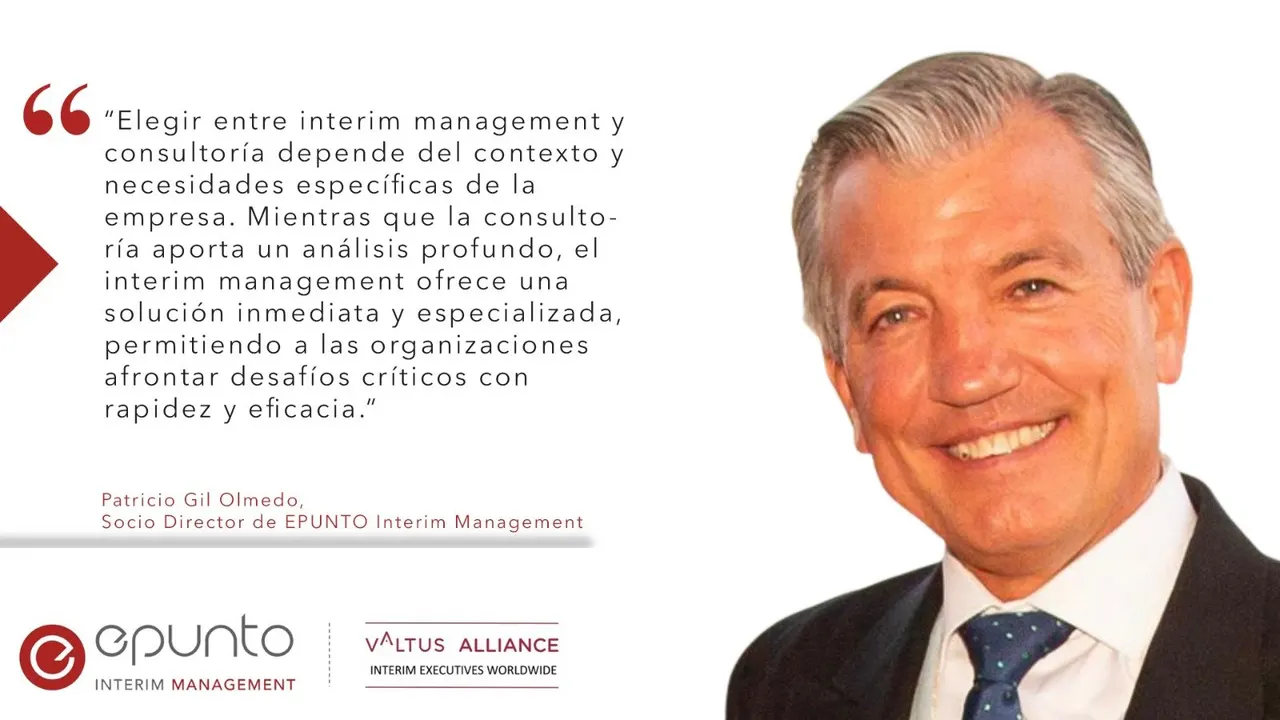
Managing Partner at EPUNTO Interim Management