
The revolution in Nepal and interim management in politics. Lessons learnt and parallels
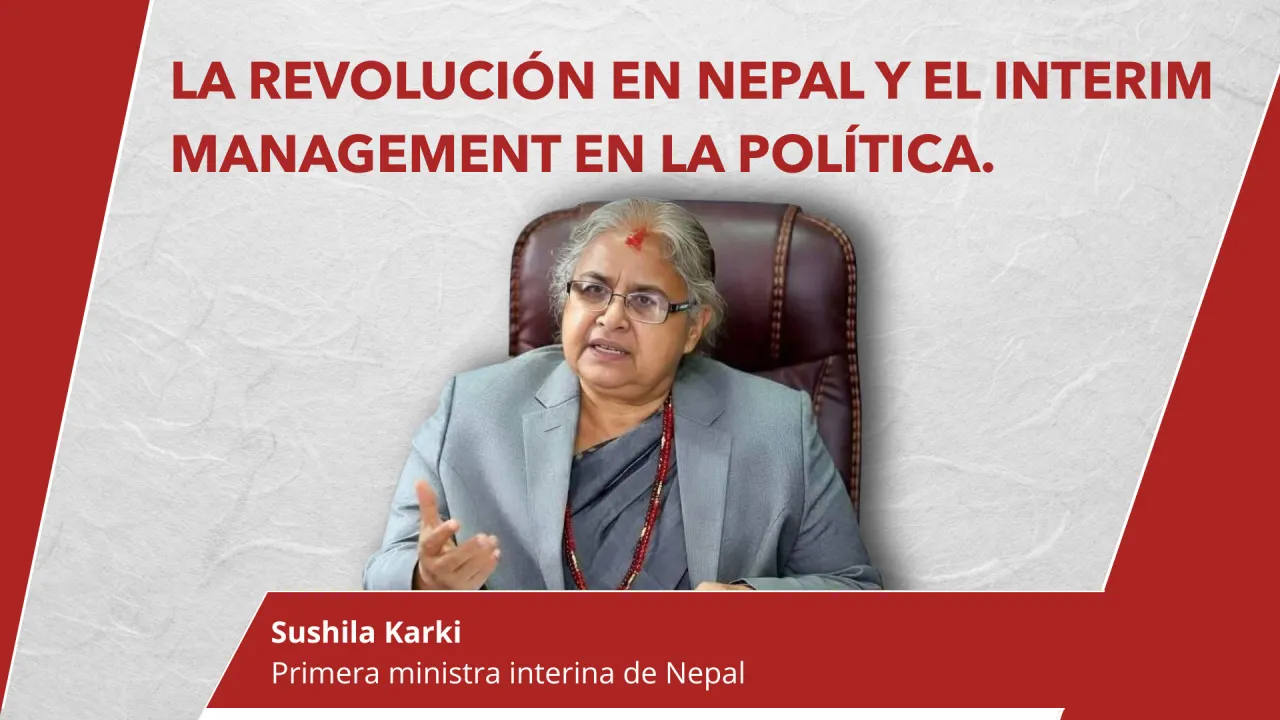
The recent crisis in Nepal, which led to mass protests spearheaded by young people in response to the imposition of restrictions on social media against a backdrop of corruption and unemployment, has culminated in the Prime Minister’s resignation and the appointment of a consensus figure: Sushila Karki, interim prime minister, who takes up the post […]
The recent crisis in Nepal, which led to mass protests spearheaded by young people in response to the imposition of social media restrictions against a backdrop of corruption and unemployment, has culminated in the Prime Minister’s resignation and the appointment of a consensus figure: Sushila Karki, interim prime minister, who takes office to organise elections and restore normality until March 2026, when elections are due to be held.
Sushila Karki was elected through a striking vote on Discord — the well-known communication platform with its roots in the gaming world — primarily by young people who took to the streets with the same vigour and determination to overthrow their country’s regime as they did to clean up the streets in the days that followed.
All this gives us some interesting food for thought, but I believe the main takeaway is how a perfect partnership has been forged between the motivation of the country’s young talent and the experience of senior figures such as Sushila, former Chief Justice of the Supreme Court.
Stabilising and articulating priorities: the essential role of interim management
Faced with scenarios reminiscent of the one mentioned above, the role of an interim manager offers specific advantages that can be applied to the business world when a swift and robust solution to internal crises is required. The appointment of a temporary authority, with a track record of neutrality and technical expertise, facilitates the management of emergencies, provides a clear point of reference for society and enables a roadmap to be drawn up to lead the organisation into a new phase with a democratically elected assignment. Thus, at the corporate level, an interim manager fulfils similar functions: they stabilise the situation, set priorities and pave the way for a handover or a return to strategic normality.
Immediate legitimacy and trust
One of the most useful lessons to be drawn from the unrest in this Asian country is the need for immediate legitimacy and trust. In Nepal, the appointment of a figure recognised for his track record sought to build trust amongst various stakeholders — primarily the army and the rebellious youth — and to expedite basic governance agreements.
It is this reputation that, in a company, is brought by an interim manager with a proven professional track record to negotiate with stakeholders, defuse tensions and restore operations. The legal and practical constraints on interim governments (such as avoiding far-reaching structural reforms and prioritising administrative continuity) also serve as a reminder: the interim manager’s actions must focus on stabilising and preparing, not on restructuring without an assignment.
“An interim manager with the right backing and support acts as a bridge: channelling the transformative energy of teams and applying the necessary rigour to ensure that changes are implemented safely and sustainably”
Youth mobilisation in Nepal has highlighted demands for the future, employment and transparency. Within organisations, on the other hand, pressure from young talent often calls for adaptation, translating into greater transparency, purpose and opportunities; whilst senior professionals are able to contribute experience, judgement and the ability to manage risks.
A defined assignment and measurement of results
However, it must not be forgotten that a temporary role with clear objectives is key, since, in the administration of countries, the interim leader has a duty to call elections and ensure due process. Similarly, any interim management service must have an assignment defined by objectives, deadlines and metrics that allow its contribution to be assessed. It is precisely this structure that facilitates accountability, enables results to be measured and leaves an operational legacy – processes, governance and a trained team – that endures when permanent executives take back the reins.
Interim leadership for complex crises
Recent experience highlights the value of interim solutions: rapid legitimacy, neutrality to mediate, the ability to organise the transition and to establish solid operational foundations. In the business world, having access to interim management services with these characteristics makes it possible to tackle extreme crises or sensitive transitions with a greater likelihood of success and at a lower reputational cost.
In short, this case provides further evidence that the use of senior executives on a temporary basis is a decision that guarantees stability and experience from the very outset. At EPUNTO, we have a network of over 60,000 professionals spread across dozens of countries, enabling us to find the best candidate in under 10 days.
Álvaro Petit— Business Coordinator & Brand Manager