Transformation Management Offices (TMOs): Governance for continuous change
Transformation Management Offices (TMOs): Governance for Continuous Change Designing a brilliant corporate strategy is often a purely intellectual exercise. However, putting it into practice becomes a complex process that requires transforming human behaviour and deeply entrenched structures. Currently, the vast majority of transformation initiatives fail during implementation due to […]
Designing a brilliant corporate strategy is often a purely intellectual exercise. However, putting it into practice becomes a complex process that requires transforming deeply ingrained human behaviours and structures.
Currently, the vast majority of transformation initiatives fail during implementation due to the constant clash between what is strategically vital and what is operationally urgent.
The conflict between day-to-day operations and strategy
In any organisation, day-to-day operations (what we call the ‘Whirlwind’) absorb almost all of managers’ energy and attention. Whilst neglecting the present can be fatal for the bottom line and customers, ignoring transformation dooms the company to obsolescence. The problem is that, when both factors compete for the same resources, the urgency of the present always ends up trumping the importance of the future.
In this scenario, entrusting transformation solely to internal leaders carries a high structural risk. An in-house manager, however capable they may be, is constrained by their own operational responsibilities, internal policies and their network of alliances. Their focus will inevitably be divided.
The necessary evolution: from the PMO to the TMO
For years, companies have managed change through Project Management Offices (PMOs), focused on tactical efficiency, costs and timelines. But today’s disruptions are not simply isolated projects, but systemic metamorphoses.
To tackle these, the Transformation Management Office (TMO) has emerged. This unit is not confined to siloed tasks; it functions as the central nervous system of change. Its role is to manage real value, shape the organisation’s culture and resolve strategic conflicts at the highest level. It acts as a dual system that protects innovation from the rigidity of day-to-day hierarchy.
External leadership: objectivity as a defence
For a TMO to be effective and not end up being swallowed up by bureaucracy, the most robust approach is for it to have external leadership underpinned by high-level interim management methodologies.
An interim manager operates outside internal politics, which gives them the necessary independence and objectivity. Their assignment is temporary and focused exclusively on executing the transformation and achieving concrete results.
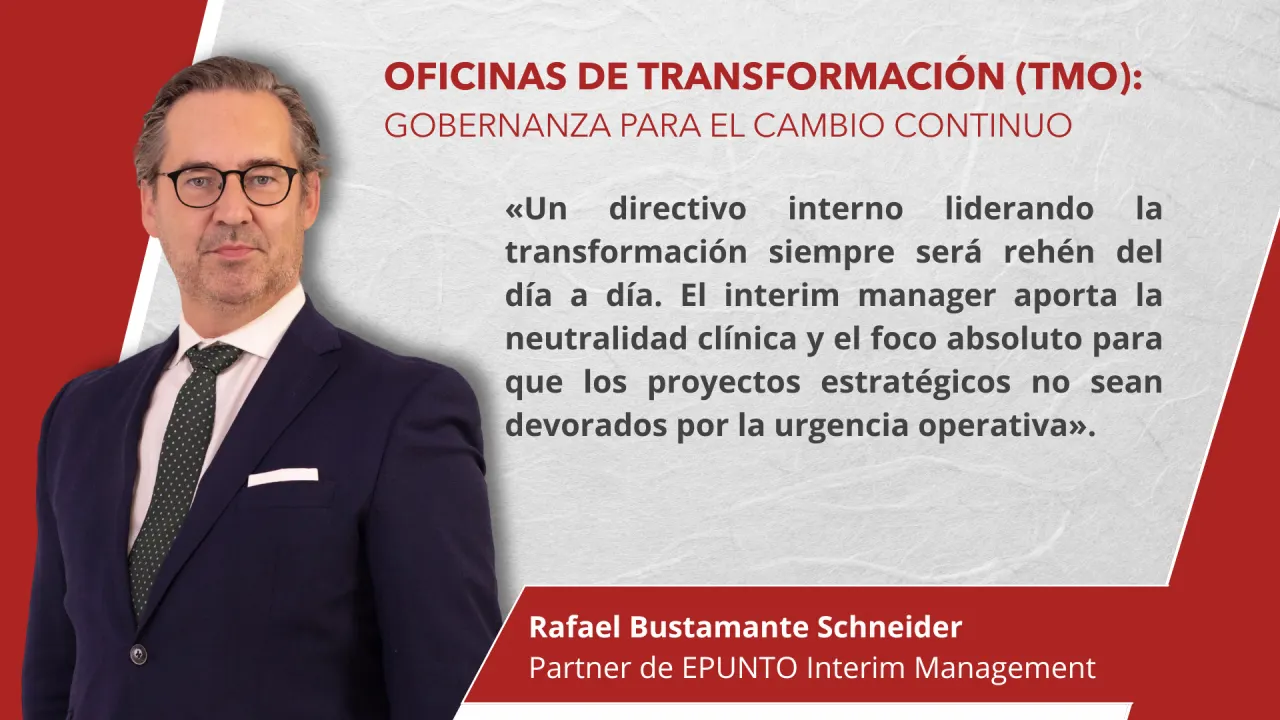
‘An internal executive leading the transformation will always be held hostage by day-to-day operations. The interim manager brings clinical neutrality and absolute focus to ensure that strategic projects are not swallowed up by operational urgency’
Rafel Bustamante Tweet
This external figure stabilises the organisation, sets priorities and shields the transformation team from day-to-day chaos. In this way, they ensure that accumulated experience (the ‘Senior Dividend’) is applied rigorously and fairly in difficult decisions, leaving a solid legacy when permanent management takes over the new processes.
At EPUNTO Interim Management, we know that governance for change is no longer optional. We have a network of over 60,000 professionals ready to lead your Transformation Office.
With our proven and audited methodology, we guarantee the recruitment of the necessary leadership talent within 72 hours so that your strategy becomes a reality.