I’m a manager – do I need training in AI?
Artificial intelligence is no longer merely a technological promise but has become a strategic reality from which many companies can, and are already, deriving benefit. However, the integration of these tools requires training and specialisation in order to com
Artificial intelligence has moved beyond being a technological promise to become a strategic reality from which many companies can, and are already, benefiting. However, integrating these tools requires training and specialisation in order to understand them and apply them effectively. This is, precisely, the greatest corporate challenge today.
A new standard in corporate leadership
Digital transformation has accelerated (particularly in recent years) the demands placed on executive boards. It is therefore no longer sufficient to delegate technological innovation exclusively to IT departments. Business leaders must have a deep understanding of how artificial intelligence can redefine strategy, optimise processes, improve decision-making and generate new revenue streams.
Reskilling at the pace set by artificial intelligence
Consequently, many executives have been forced to accelerate their reskilling in order to update their digital skills and keep pace with innovations such as generative AI and agent-based applications. This is because a failure to adapt to technological change no longer merely results in a loss of competitiveness for companies; it has become a decisive factor in retaining and attracting top-tier executive talent.
EPUNTO’s perspective: a turning point in executive talent
This reality is clearly evident in the day-to-day work of executive transition managers. Patricio Gil Olmedo, Managing Partner at EPUNTO Interim Management, highlights a clear market trend that is redefining recruitment standards for senior management.
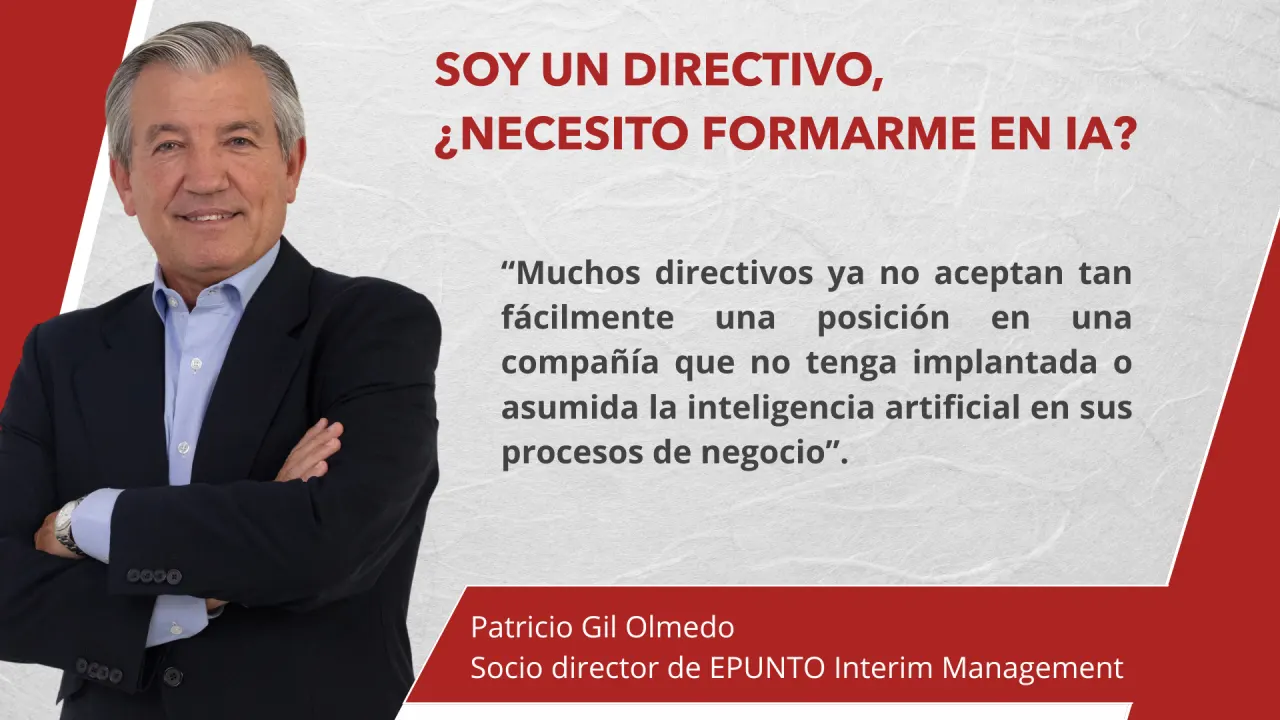
“Many executives are no longer so quick to accept a position in a company that has not implemented or embraced artificial intelligence in its business processes” — Patricio Gil Olmedo, Managing Partner at EPUNTO Interim Management
“There is a critical need amongst senior executives to learn and train in all matters relating to artificial intelligence,” notes Gil Olmedo. “In my day-to-day work, it is common to hear from executives who, after leaving a company, are focusing their efforts on training in artificial intelligence applied to business. Several of them tell me they’ve made a firm decision: they won’t readily accept a position in a company that hasn’t implemented or embraced AI in its business processes,” adds the Managing Partner of EPUNTO Interim Management. An executive does not need to learn how to programme artificial intelligence, but they do need to understand it strategically so that their company does not become obsolete.
Recommended by LinkedIn
The Role of Artificial Intelligence in the Success of… Heisson Nessi 2 years ago CEO: from replaceable to indispensable with AI Octavio Fernandez Ph.D. 6 months ago Delegating vs Empowering in the Age of AI: 5 Arguments… Juan J. Moreno 10 months agoWhy AI is now an essential requirement for senior management
The reluctance of highly qualified managerial talent to join organisations lagging behind in AI adoption is not a whim, but a new interpretation of the market. This stance is based on five key arguments, according to Patricio Gil Olmedo:
- Market pressure: Boards of Directors, investors and customers are increasingly demanding roadmaps that integrate AI natively into the business model.
- Vision and strategic survival: Executives are aware that companies which ignore AI will lose their competitive advantages in the short term and will face serious risks to their viability.
- Operational efficiency: Intelligent automation and predictive data analysis are fundamental pillars for maintaining sustainable margins in uncertain environments.
- Informed decision-making: Understanding AI enables leaders to anticipate market changes and underpin their strategies with accurate data, reducing the margin for error.
- Leadership gap: Employees are adopting AI on their own initiative (productivity tools), and executives risk losing control over governance and security if they do not understand which tools are being used.
At EPUNTO Interim Management, we observe that the leaders of the future – and those driving change today – are those who combine their solid management experience with a strategic grasp of artificial intelligence. The question for organisations is no longer whether they should implement AI, but whether they are prepared to attract managers who know how to lead its implementation.
For organisations seeking to accelerate this technological transition with full confidence, having agile and well-prepared leadership is key.
At EPUNTO Interim Management, we facilitate access to highly qualified interim executives, ready to guide strategic change from an innovative perspective grounded in experience.