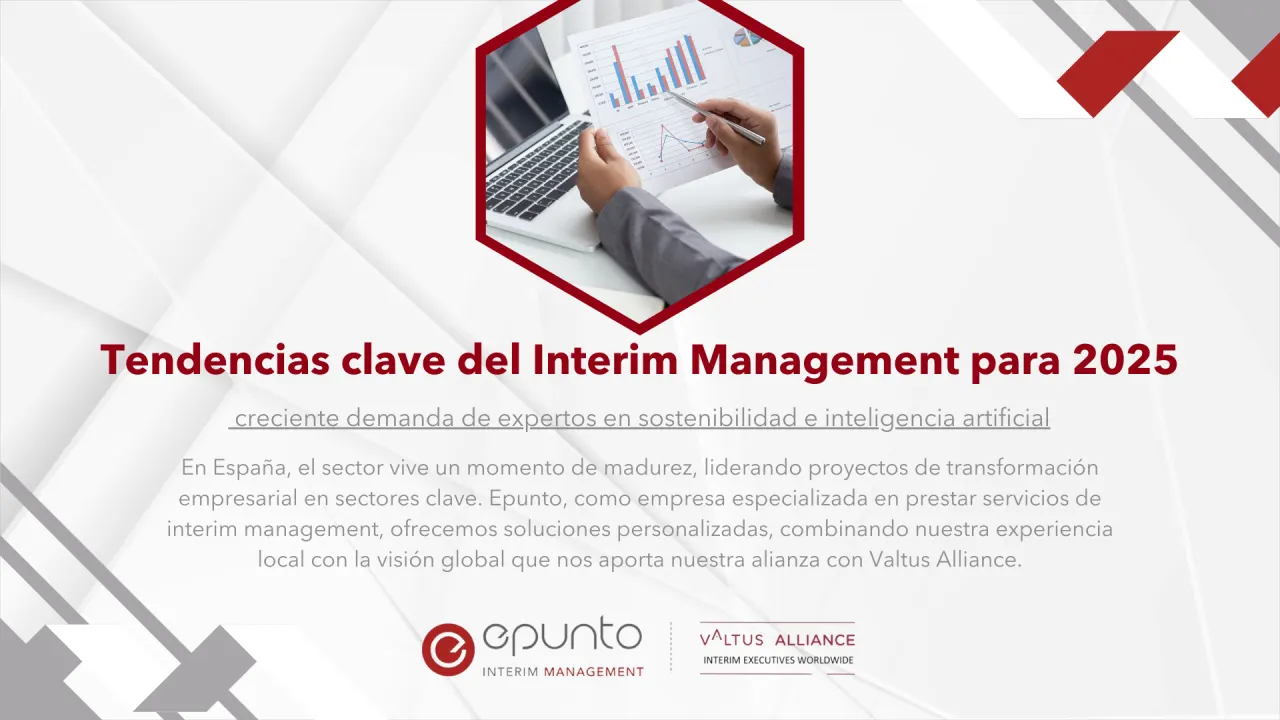
Key trends in interim management for 2025
Interim management has established itself as an essential tool for tackling the most complex challenges of today’s business environment. As companies face a 2025 marked by uncertainty, technological advances and social demands, emerging trends in the sector reveal a landscape of strategic opportunities. In this article, we explore the key factors that […]
Interim management has established itself as an essential tool for tackling the most complex challenges of today’s business environment. As companies face a 2025 marked by uncertainty, technological advances and social demands, emerging trends in the sector reveal a landscape of strategic opportunities. In this article, we explore the key factors that will shape the future of interim management and how organisations can capitalise on them to ensure their competitiveness.
Specialised profiles: sustainability and artificial intelligence as priorities
The growing focus on ESG (environmental, social and governance) criteria is transforming organisations’ priorities. There is an increasing demand for interim management services with expertise in sustainability, and for service providers with specialists capable of implementing comprehensive strategies that not only comply with current regulations but also strengthen corporate reputation and attract responsible investment. According to recent reports, more than 50 per cent of companies in Europe expect to implement decarbonisation programmes over the next three years – an opportunity that interim managers are successfully leading.
At the same time, the adoption of artificial intelligence and emerging technologies is redefining the way companies operate. From supply chain optimisation to the automation of key processes, digital transformation projects require expert services that not only master the technological tools but also know how to manage the cultural and organisational impact of these changes. Companies providing interim management services are proving to be the ideal bridge between technological innovation and practical implementation (effective and with a low risk of failure) in complex business scenarios.
Organisational flexibility: new working paradigms
The pandemic accelerated the roll-out of hybrid working models, but the real challenge in 2025 will be to optimise these formats to ensure both productivity and team cohesion. In this context, interim management firms play a crucial role in designing flexible organisational structures that adapt to market demands, reduce operating costs and foster talent retention.
Companies that have engaged interim management services during their organisational restructuring processes highlight their ability and effectiveness in acting as neutral agents, capable of identifying areas for improvement without internal bias and implementing changes swiftly and effectively.
The case of Spain: an evolution marked by market maturity
In Spain, interim management is undergoing a period of rapid maturation. Although it has historically been associated with more developed markets such as the UK or France, over the last five years it has grown exponentially in sectors such as industry, technology and financial services.
A recent study reveals that 70 per cent of interim management projects in Spain are linked to business transformation, with corporate restructuring and international expansion strategies standing out as the areas in greatest demand. Furthermore, there has been a significant increase in the use of interim management services by start-ups, particularly those seeking to accelerate critical processes such as funding rounds, internationalisation or the implementation of advanced digital systems.
How to maximise the value of interim management
For companies, making the most of the opportunities offered by interim management requires a clear strategy. This includes:
- Defining specific objectives: interim projects must have clear and measurable goals from the outset.
- Working with specialist firms: to identify the most suitable candidates quickly, effectively and without risk, and to oversee the services provided as the only way to maximise success.
- Fostering integration: ensuring that the interim manager can work in synergy with internal teams, thereby accelerating the implementation and transition process.
Conclusion: leading change through excellence and global collaboration
Interim management is not simply a tool for tackling complex situations; it is a transformative strategy that enables companies to adapt and thrive in an ever-changing business environment. By 2025, the use of specialist services in sustainability and technology, combined with organisational flexibility, will be the cornerstones upon which business success is built.
At EPUNTO Interim Management, we not only bring our local expertise to bear, but also expand our reach and capabilities through our membership of the Valtus Alliance, a global network of leading interim management firms. This collaboration gives us access to shared knowledge, international best practice and a network of highly qualified professionals worldwide, enabling us to offer innovative and strategic solutions tailored to each client.
With this strong alliance and our commitment to excellence, we are ready to help businesses tackle the challenges of the future, lead their transformations and reach new heights of success. Trust EPUNTO Interim Management and the Valtus Alliance as your strategic partner for a sustainable, digitalised and competitive business future.