How consultancy firms are shifting towards management: The importance of execution
Consultancy firms are evolving; it is no longer enough simply to offer assessments and theoretical presentations. The market demands that firms take action and implement strategy through figures such as interim managers to ensure measurable results.
The business ecosystem has been undergoing a profound transformation for years. For decades, the main value provided by consultancy firms lay in in-depth analysis and high-level strategic design. However, the pace of today’s market demands that we go one step further and truly take the initiative.
Beyond strategy: The evolution of ‘PowerPointism’
The value of consultancy has traditionally been measured by its ability to diagnose problems and design strategies: companies have for years relied on meticulous reports and flawless presentations as their main roadmap. However, today there is an ever-widening gap between theoretical proposals and actual execution in day-to-day operations.
We are witnessing what many are already describing as the end of ‘PowerPointism’. This trend does not seek to invalidate strategic thinking, but rather highlights a current shortcoming: organisations are no longer looking merely for advice; they prioritise relationships with Partners who get involved in implementing solutions and take responsibility for the results. Advice is becoming cheaper. Execution is not.
The sector’s large, well-established firms—BCG being the latest example—have taken note and are strengthening their teams with operational management profiles to ensure that their plans do not remain on paper but become tangible realities. Building a service offering that brings execution capability to the business – not just advice – is a rational and intelligent move.
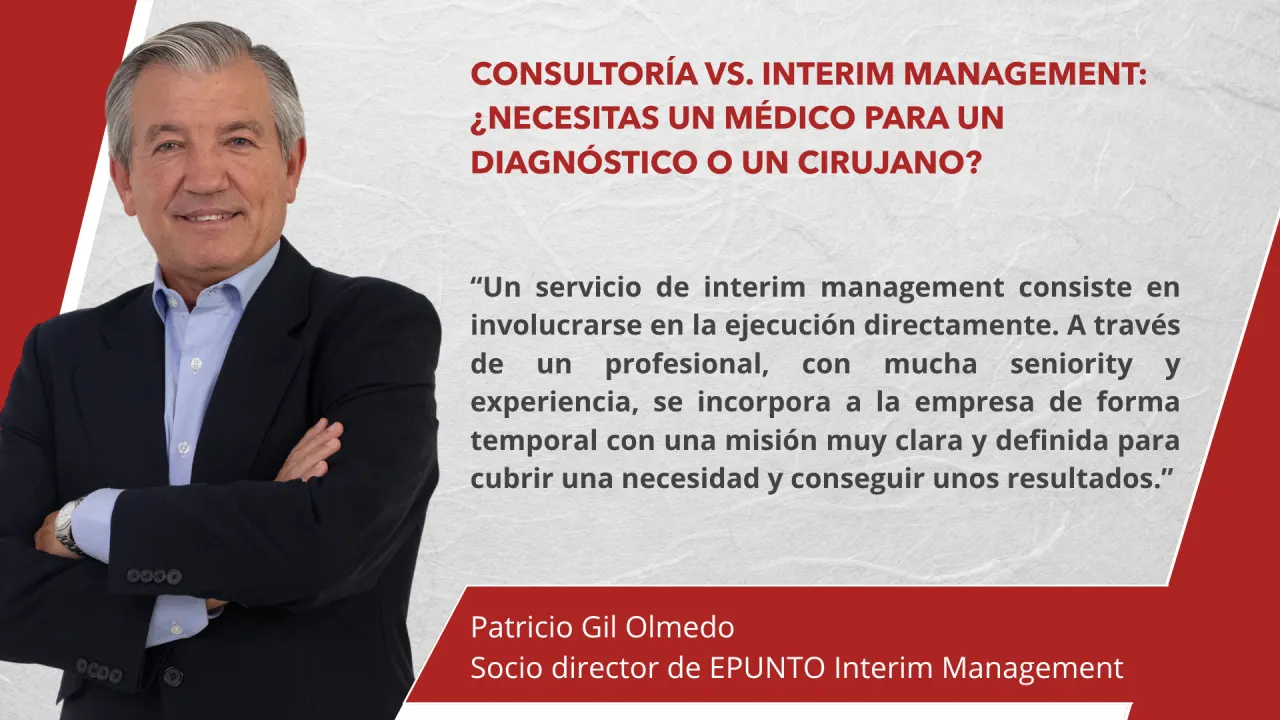
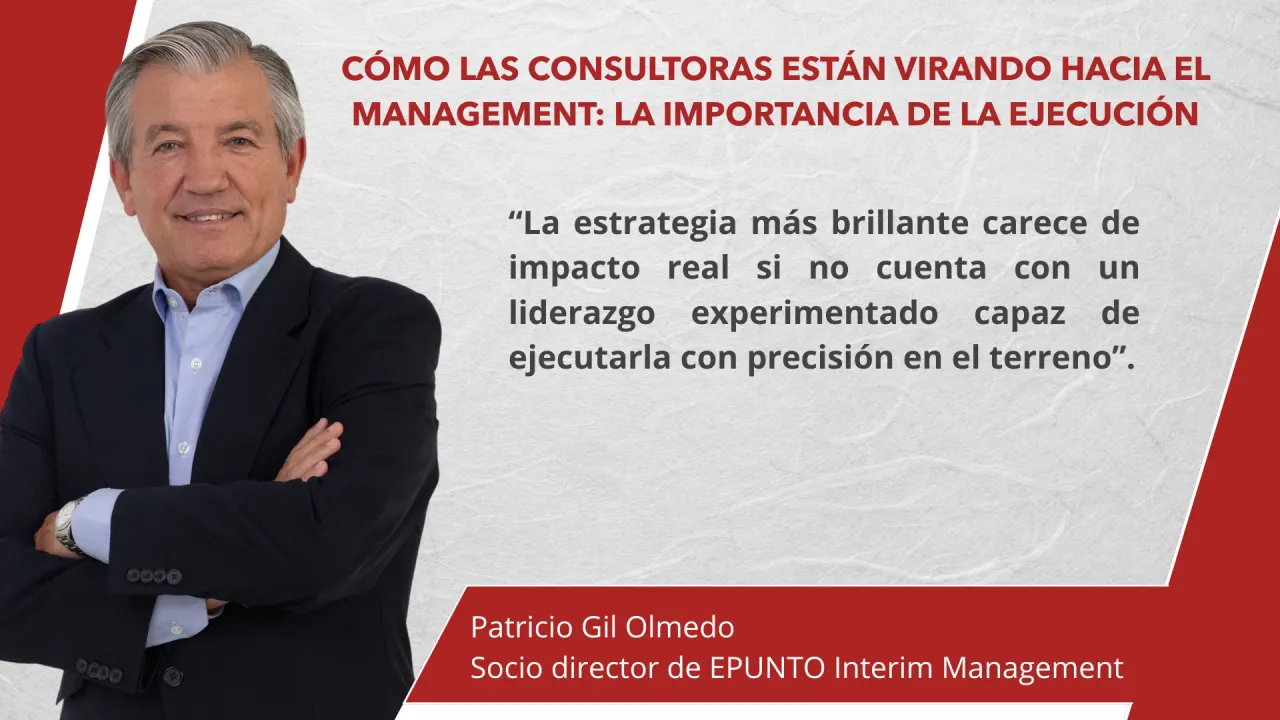
“Even the most brilliant strategy lacks real impact if it does not have experienced leadership capable of executing it precisely on the ground.” – Patricio Gil Olmedo
Execution as the true driver of change
The shift towards direct management responds to the need to achieve measurable, short-term results. This is where interim management comes into its own as a key link in the chain. Unlike the traditional advisory role, this approach is action-oriented:
- Integration into the organisation: The professional takes on genuine executive responsibilities within the company’s structure and operations.
- Team leadership: They manage, motivate and align internal talent to pull in the same direction during the period of change or transition.
- Translating objectives into action: They break down broad strategic plans into daily operational milestones to deliver results.
We are talking about high-impact situations where the margin for error is virtually zero. Scenarios such as mergers and acquisitions (M&A), a far-reaching operational restructuring, generational succession in a family business or a corporate digital transformation are processes that do not allow for lengthy internal learning curves. In these critical contexts, having an experienced leader who has already overcome similar challenges in the past not only accelerates the achievement of the goals set by the consultancy, but also mitigates risks, bringing stability and proven expertise from day one.
From fixed costs to premium talent ‘as a service’
This paradigm shift is also deeply linked to companies’ financial optimisation. The transition is clear: the market is moving inexorably towards the adoption of premium executive talent on an ‘as a service’ basis. This model offers undeniable strategic advantages:
- Absolute flexibility: It allows top-level executives (CEOs, CFOs, Operations Directors or HR Directors) with proven track records to be brought on board solely for the duration of the project.
- Financial efficiency: It transforms a long-term structural cost into a variable investment, focused on a clearly defined return on investment (ROI).
- Operational independence: As they are not constrained by internal politics or the existing corporate culture, interim executives provide an objective perspective focused exclusively on achieving objectives.
At EPUNTO Interim Management, we view this market trend as validation of our core mission. The future of corporate consultancy inevitably lies in executive delivery.
Providing companies with interim leaders—capable of launching projects, executing strategy and delivering results—has ceased to be a mere trend and has become the true driver of growth for the most competitive organisations. Speed of execution, financial rigour and the ability to drive change whilst maintaining organisational stability. These are skills that not all experienced managers possess, and the window of opportunity to bridge these gaps is narrow.
The benefits are clear, and we hear this from clients after their first experience with us: ‘We should have done this sooner.’