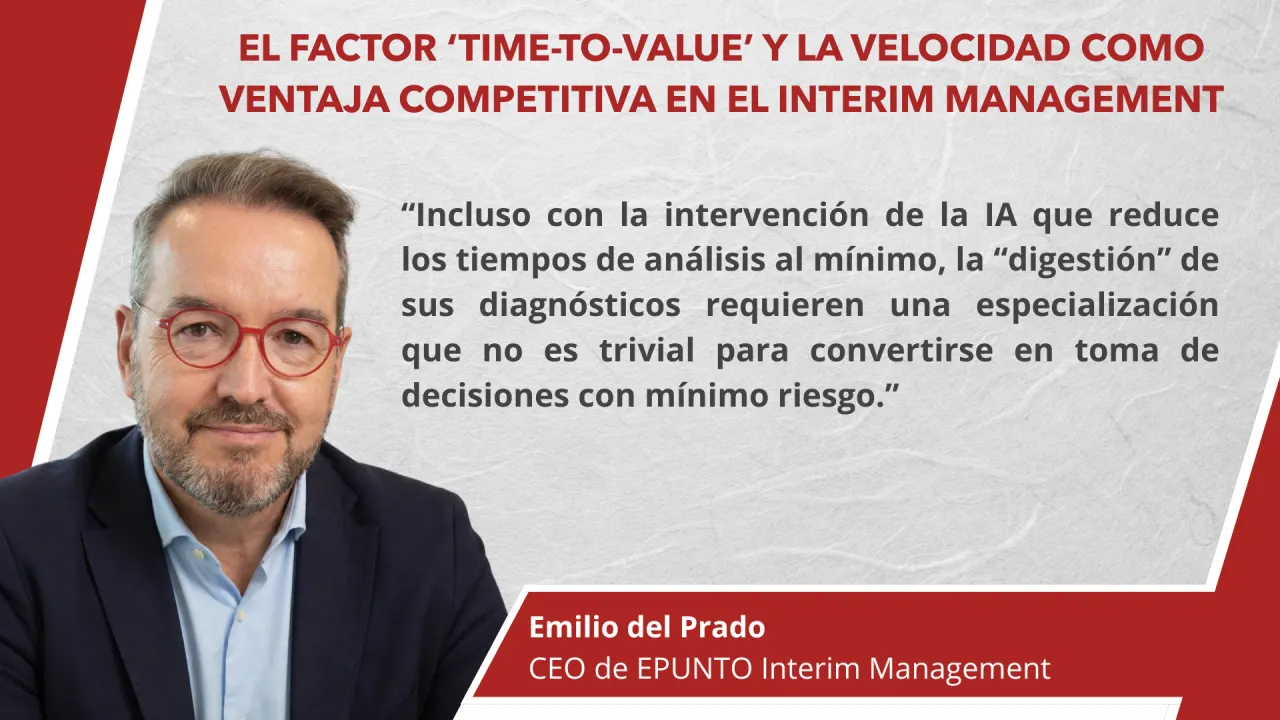
The ‘Time-to-Value’ factor and speed as a competitive advantage in interim management
In a market characterised by short cycles, slowness is a disadvantage. Interim management drastically reduces ‘time-to-value’ by bringing in senior talent who make an immediate impact, enabling solutions to be implemented without the need for lengthy internal learning curves.
Today’s market severely penalises indecision. We are facing an economic climate characterised by increasingly short cycles, where ‘traditional’ organisational structures are beginning to reveal their obvious weaknesses, as they prove too slow to respond to change. The reality of day-to-day business shows us that decision-making must be a process far more agile than the fluctuations of the business environment itself.
Accepting that a conventional recruitment process takes months to bring on board a key executive is a direct hindrance to the competitiveness of any business. The moment an unforeseen problem arises or, conversely, a good opportunity for growth presents itself, the clock starts ticking against us and time immediately becomes the company’s most valuable resource.
Goodbye to long learning curves
In certain corporate contexts, there is a widespread belief that any professional intervention requires an extensive period of preliminary assessment. In critical situations, such as mergers, restructurings or major digital transformations, there is absolutely no margin for error, and the urgency of day-to-day operations makes it impossible to allow for the usual time needed for internal adaptation.
Today’s organisations demand tangible solutions rather than lengthy analyses. Consequently, traditional consultancy often spends weeks producing a status report or drawing up future plans. Even with the use of AI, which reduces analysis times to a minimum, ‘digesting’ its findings requires a level of expertise that is by no means trivial in order to translate them into decisions with minimal risk. Faced with this dynamic, interim management steps directly into the realm of execution.
The true value of ‘Time-to-Value’
The concept of ‘Time-to-Value’, understood as the time it takes for an action to have a positive impact on the company and generate genuine value, marks the fundamental difference between truly agile companies and those that are losing ground. The key lies in measuring the exact time span from when a challenge is identified until the solution adopted has a positive and tangible impact on the profit and loss account or day-to-day operations.
This methodology completely transforms the way crises and business challenges are tackled. On the one hand, an interim manager possesses the necessary experience in similar situations to join the company and take action within a few days, which drastically reduces corporate response times. Furthermore, this role moves away from mere theoretical discussions to get stuck into the day-to-day operational grind, taking personal responsibility for the figures and ensuring that strategies are implemented. From the very outset, this professional brings stability and takes the reins of the team to steer it towards specific objectives.
Direct impact and flexible structures
Corporate agility is no longer measured by the number of people on the payroll. Today, it is assessed by the ability to bring in the right talent at the right time. The interim executive has a mission with an expiry date: their purpose is to resolve a specific challenge, lay a solid foundation that can operate autonomously in the future, and ensure that all this knowledge is transferred to the in-house team before their contract ends.
Maintaining a cumbersome structure that is unable to absorb talent on demand poses a huge risk to the survival of a business venture.
At EPUNTO Interim Management, a Valtus Alliance member, we pose a key question for business leaders. Faced with the next major corporate challenge, it is worth asking whether the organisation will move at the slow pace dictated by its own bureaucracy or whether it will be able to adapt to the speed demanded by today’s market. Those seeking real momentum, direct change management and verifiable results need highly decisive individuals.
Sometimes, a company does not need an analyst to assess the situation; it requires an experienced surgeon ready to operate immediately.