
A crisis doesn’t force you to make bad decisions, but it does make you make them too late
The halo effect, confirmation bias and analysis paralysis explain why, in a crisis, decisions are rarely wrong: they are simply made too late. Juan Manuel Gil de Escobar explains how an external perspective breaks this inertia.
Let’s imagine a fictional, though perhaps familiar, scenario: an executive watches as his business unit racks up months of losses following a slow and steady decline in sales. On paper, he believes he has a clear diagnosis, because, after all, he has the best sales team and a brilliant sales director who, in the past, has always delivered exceptional returns.
However, this seemingly rosy picture masks a common pitfall in managerial decision-making: the ‘halo effect’. In this particular case, it is a perception of the team’s talent, based on past successes, which clouds any truly objective assessment of the present.
With these ideas in mind, the manager asks the sales department for figures and projections to explain the decline. However, rather than asking an open-ended question, he sets the agenda himself, seeking figures that will confirm what he has already decided is happening. Inevitably, confirmation bias comes into play. The data (or rather, the biased interpretation of it) proves him right. Everything is as it should be and, consequently, he decides to wait for the company to bounce back.
But the expected recovery fails to materialise. Faced with a lack of results, our protagonist demands more reports and spreadsheets, but nothing changes. The new information begins to clash with his mental model, and instead of shifting his perspective, he falls into analysis paralysis.
Months go by. The pressure to deliver results mounts until it becomes unbearable and, inevitably, claims its first victims. Suffocated by the urgency, the manager ends up making a drastic decision, based on the reaffirmation of his impressions and carried out in haste: cutting the sales team. Under pressure, they resort to the most obvious reflex – cutting costs – without having reviewed any of their decision-making premises, despite continuing to believe in them.
Thinking deliberately before acting: a simple yet crucial skill in corporate environments
As an outcome and a lesson, if this leader had paused to deliberate in a methodical manner, free from preconceptions, he would have seen a very different reality. The problem was never with his team, but with the overall approach. The competition had begun to integrate new and innovative technologies, such as artificial intelligence, which enabled his rivals to offer customers more comprehensive services at much lower prices. The staff cuts, as well as being too little, too late, were aimed at the wrong target.
As Juan Manuel Gil de Escobar, Managing Partner at EPUNTO Interim Management, points out, “the problem is not that you don’t know what to do, but that your brain gives you reasons to trust your initial intuitive approach”. Thus, “a crisis arises not so much from a lack of information, but from the inadequate processing of that information”.
To continue with the example, our fictional manager was neither incompetent nor lazy; he was simply trapped within his own mind and his own information. This is because biases do not feel like mistakes; they feel like common sense. And that common sense—which is nothing more than information governed by intuition drawn from accessible past experiences—tends to ignore evidence-based data and careful analysis. Acting on these impressions leads to poor decisions, solutions come too late, and the cost is always high.
The architecture of human judgement
In his celebrated work *Thinking, Fast and Slow*, the psychologist and Nobel Laureate in Economics Daniel Kahneman—who conducted research for decades alongside Amos Tversky—illustrates precisely how these mechanisms operate. Human judgement constantly relies on mental shortcuts that lead us to make systematic and predictable errors. Far from being random mistakes, these missteps follow very specific and structured patterns, which derail our rationality at crucial moments. Kahneman distinguishes between two modes of thinking: System 1, which is fast, automatic and intuitive, and System 2, which is slow, deliberate and requires effort. The three biases in our story are, in essence, System 1 taking the lead whilst the manager believes they are using System 2.
“Our mental architecture is designed to adapt to a changing environment swiftly and nimbly, whilst saving as much effort as possible, which is a triumph of human evolution.” —Juan Manuel Gil de Escobar, Managing Partner at EPUNTO Interim Management
However, as Juan Manuel points out, “it would be profoundly unfair to conclude that our brain is ‘poorly designed’. Quite the opposite. Our mental architecture is designed to adapt to its changing environment swiftly and nimbly, whilst conserving as much effort as possible, which is a triumph of human evolution”. As the executive points out, biological progress has favoured those who thought quickly, ensuring survival and the correct response to dangers—something crucial in environments far less social and far more challenging than a boardroom.
The emotional component
However, this rapid intuition is not always applicable to the business ecosystem. Running a company is a complex environment, often ambiguous and full of decisions that require time. Intuition is necessary, of course, but when emotional factors such as fear or loss aversion come into play, the mind tends to push us towards quick—and often mistaken—solutions.
Critical thinking as an ally
Against this backdrop, critical thinking stands out as the tool capable of restricting such rapid decision-making to only those moments when it is truly required. The great managerial challenge is to overcome confirmation bias in order to clearly discern what real evidence is available on a given issue. And this critical thinking does not apply only to data from others; it must also be applied to oneself, by questioning one’s own assumptions.
How do biases influence us?
In the words of Juan Manuel Gil de Escobar: “Biases are wrong answers to a question that hasn’t been asked.” To avoid this cognitive trap, it is advisable to ask the right question in each case.
Regarding the halo effect: what evidence do I have of this team’s performance today, beyond the track record I am using as a reference?
When dealing with confirmation bias: what information would make me change my mind, beyond what I am currently considering?
When dealing with analysis paralysis: what would I decide if, at this very moment, I could not request a single further report?
At this point, the role of the interim manager takes on strategic value. A transitional manager arrives without the burden of the company’s history or culture. Their effectiveness is underpinned by pillars that counteract internal inertia:
- Independence of judgement: As they are not a structural part of the project nor do they identify emotionally with it, their judgement is not coloured by the past.
- Absence of ties: They do not rely on past decisions (whether their own or those of others), are not bound by previous loyalties, and have no emotional incentive to defend a particular position.
- Recognition of patterns: They know how to react judiciously by recognising patterns in situations identical to those they have already faced throughout their career.
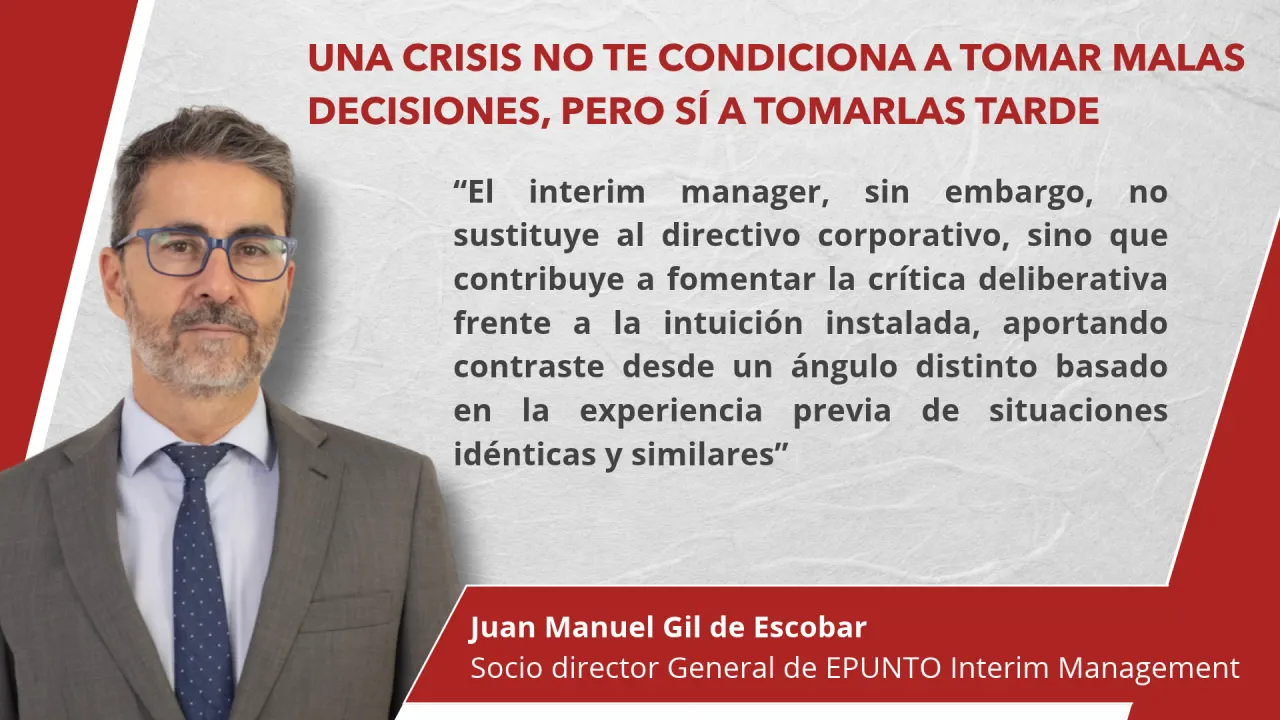
“The interim manager, however, does not replace the corporate executive, but rather helps to foster deliberative criticism in the face of entrenched intuition, providing a contrasting perspective from a different angle based on previous experience of identical and similar situations.” —Juan Manuel Gil de Escobar, Managing Partner at EPUNTO Interim Management
At this point, it is worth asking: what would have changed if the executive in our opening story had made a decision months earlier, or if he had drawn on an external perspective to inform his deliberations? The company would probably have realised its technological disadvantage in good time and would have been able to react without having to sacrifice its sales team. This reaffirms our main thesis: in crises, it is not that decisions are made badly, but that, generally speaking, they are simply made too late.
What excuses are we giving ourselves today for waiting?
Before intuition dictates the next move, it is worth asking ourselves: what decision are we postponing, and what internal reason are we giving ourselves for waiting?
If your organisation is facing a period of uncertainty, commercial stagnation or needs to reassess its roadmap, at EPUNTO Interim Management we provide the necessary interim management talent to integrate into the company, carry out a rapid assessment and implement solutions. We provide an external perspective and a method that help your company make decisions in good time.