Interim management as a source of added value for the private equity sector
Given the volatility and high valuations, funds need to refine their asset selection and execution. Patricio Gil Olmedo explains the role of interim management in operational due diligence, the first 100 days and the path to exit.
The private equity market has recently been facing a complex landscape. Given the current volatility and high valuations, funds need to refine both their asset selection and the execution of their value creation plans as much as possible. In this context, interim management is establishing itself as a key resource, going beyond simply being a response to potential unforeseen events.
Operational ‘due diligence’
Traditionally, private equity firms have focused their attention on financial, tax and legal audits. However, to gain an accurate understanding of a business’s actual operations, identify hidden inefficiencies or anticipate bottlenecks, operational due diligence – or commercial due diligence – can really make all the difference.
Before finalising a transaction, having professionals with in-depth knowledge of the target company’s sector provides a perspective that is difficult to obtain from the outside or by relying solely on financial experts. The experience and knowledge of industry professionals enable the identification of risks in critical areas and a more accurate analysis of the management team’s capabilities and performance.
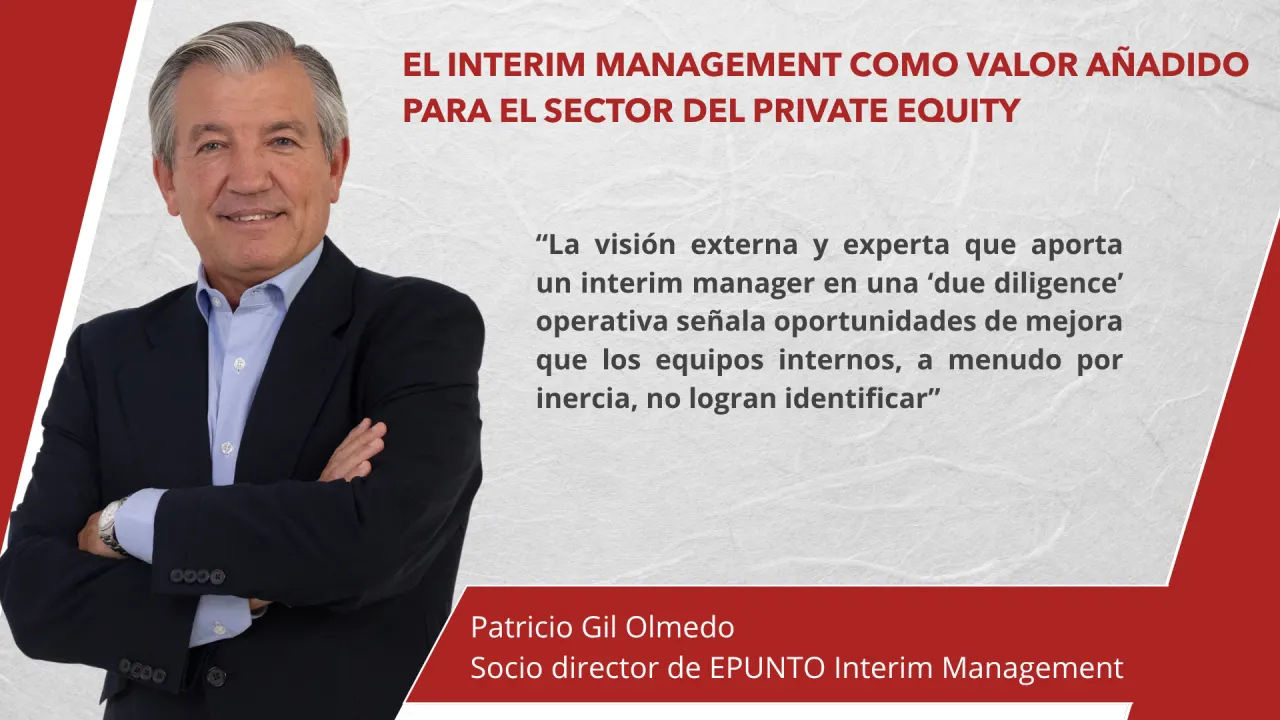
“The external, expert perspective provided by an interim manager during operational due diligence highlights opportunities for improvement that internal teams, often due to inertia, fail to identify” — Patricio Gil Olmedo, partner at EPUNTO Interim Management
On this point, Patricio Gil Olmedo, partner at EPUNTO Interim Management, notes that “operational reality often goes beyond financial processes. The external, expert perspective provided by an interim manager at this stage not only mitigates risks prior to the formalisation of the acquisition, but also highlights opportunities for improvement that internal teams, often simply out of habit, fail to identify”.
The importance of the first 100 days
Once the agreement to acquire a stake in the asset has been signed, time becomes a critical factor. The first 100 days are particularly important for taking control, aligning the corporate culture and establishing new standards for management and, above all, reporting. Often, acquired companies (whether family businesses in transition or fast-growing firms) lack the executive structure needed to cope with the demands and pace required by an investment fund.
Transition talent as a value accelerator
It is at this post-acquisition stage that interim executive talent can step in swiftly on several strategic fronts:
- Ensuring stability: Filling critical roles (such as CEO, CFO or COO) to prevent leadership vacuums whilst a permanent candidate is being selected.
- Leading integration (M&A): Steering growth processes to ensure that the consolidation of systems, teams, processes and cultures generates short-term value rather than destroying it.
- Professionalising management: Optimising processes and implementing scalable technological tools that prepare the company for a future ‘exit’.
Immediacy is, therefore, a key factor. “The greatest advantage of interim management in the post-acquisition phase is providing specialist, autonomous and decisive profiles,” explains Patricio Gil Olmedo. “An interim manager does not require a learning curve, as they integrate into the company, make a rapid assessment, execute the plan and begin to deliver tangible results from day one, optimising the fund’s time and profitability.”
Absolute independence and objectivity
However, if there are two qualities that particularly define the effectiveness of an interim manager in the private equity sector, these are their independence and their strict objectivity. Unlike a traditional executive, the interim manager has no pre-existing internal ‘political’ interests, does not seek promotion within the company and is free from historical emotional ties to the organisation’s past.
Their sole priority is to meet the project’s objectives within the agreed timeframe. This autonomy enables them to take complex decisions (such as restructuring operational areas or winding up unprofitable business lines) with the analytical rigour and decisiveness required by private equity funds.
A solid bridge to the ‘exit’
Having the right managerial talent is the surest way to link the initial investment thesis to a successful exit. A leader capable of combining strategic vision with the ability to execute represents the best risk mitigation mechanism in any transaction.
Whether a private equity fund or investment team is in the midst of a ‘due diligence’ process or needs to drive growth, restructuring and integration within its portfolio companies, at EPUNTO Interim Management we have the high-level executive profiles required to meet these challenges. Our experience across a wide range of services enables us to support and add value to these processes.
Let’s discuss the specific needs of your portfolio and how interim management can help accelerate execution and maximise the value of each investment. Our team is at your disposal to identify each company’s priorities and define the management approach best suited to each case.