
Generative AI in business: what’s already working, what’s still just hype, and what nobody tells you about the risks
Now that the initial excitement has subsided, boards are no longer buying into sales pitches: they demand ROI, scalability and risk management. Rafael Bustamante analyses what brings real value, what constitutes sales talk, and how AI is reshaping leadership talent.
Generative artificial intelligence has come to the fore in recent months, taking centre stage on management committees’ agendas. However, once the initial euphoria has subsided, companies are faced with the reality of the corporate environment: shareholders and Boards of Directors are not interested in technological demonstrations; they demand a return on investment, scalability and, above all, risk management.
From the perspective of business transformation, what is now required is an honest analysis capable of explaining what is delivering real value, what is mere sales rhetoric, and how this technological disruption is reshaping even the way in which companies recruit management talent.
From individual productivity to the ‘super-user’
Individual productivity is one of the areas where generative AI is already demonstrating, even in the short term, an undeniable return on investment. Professionals who have integrated these tools into their day-to-day work are achieving remarkable efficiencies in analysis, synthesis and corporate writing tasks.
But the true transformative impact lies in the emergence of what is known in tech jargon as the ‘super-user’. Consider an operations or finance manager who does not simply use AI to draft emails, but takes it a step further towards personalisation. How? By training their applications with historical data to model financial stress scenarios, detect bottlenecks in the supply chain or programme complex macros without being a developer.
These types of users, whose use of AI exceeds the average, are significantly boosting their performance in specific tasks to the point of becoming high-performing professionals.
The structural redesign of processes beyond ‘chatbots’
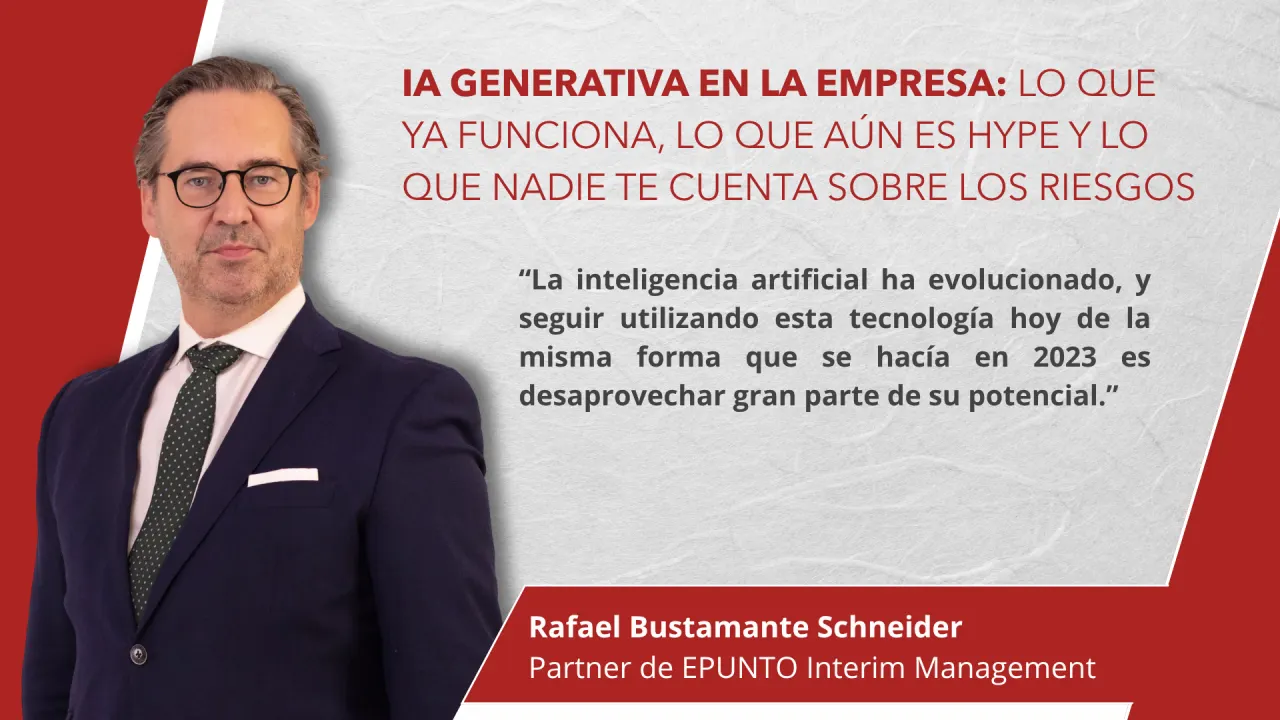
Consequently, one of the main mistakes made during the technology adoption phases in companies is limiting the vision of AI to the use of ‘chatbots’. Artificial intelligence has evolved, and continuing to use this technology today in the same way as in 2023 is to squander much of its potential.
The ‘hype’, stalled pilot projects and the hidden cost
Despite isolated successes, adopting artificial intelligence is a process of trial and error in which the vast majority of pilot projects never make it to production. Why is this? It is one thing to get a model to generate a correct response in a controlled environment, but quite another to integrate that model into open systems, ensuring the greatest possible accuracy in an environment where the model’s ‘hallucinations’ can cost millions.
Furthermore, the true cost of the technology is often underestimated. The ‘hype’ makes licences seem affordable, but it overshadows the costs of scaling it up. And so, when a company moves from a trial with ten users to a roll-out for thousands of employees and its own databases, the cost of ‘tokens’ (the units used to process the models) skyrockets. Added to all this are data cleansing, cybersecurity, cloud infrastructure and ongoing model maintenance.
What are the main risks? Reputation, legal compliance and operations
Implementing AI without a strict governance framework can entail countless risks for the company, all of which require active and expert management:
- Legal and privacy risks: The leak of confidential information or intellectual property when feeding sensitive data into public models is a latent threat. Furthermore, compliance with regulations such as the GDPR or the new European ‘AI Act’ requires constant review.
- Reputational risk: An unsupervised model that generates discriminatory biases or false information for customers can have a very negative impact on a brand’s image.
- Operational risk: Over-reliance on a specific technology provider can paralyse critical operations if their pricing policies change or they experience service outages.
Interim management in the age of AI: new leaders for new challenges
This technological and organisational complexity is having a direct impact on management talent and, in particular, in the field of interim management, giving rise to new categories of professionals:
- ‘Enhanced’ interim manager: Today’s interim managers can become even more productive. They have the ability to discern when AI should be applied and when human judgement and empathy are indispensable – something that is essential in today’s world.
- Interim CAIO (Chief AI Officer): Companies need to plan their AI strategy, but often cannot justify a long-term permanent role or struggle to find the ideal candidate for it. The role of a temporary AI director enables the company to establish an ethical framework, launch the first viable projects and lay the technological foundations for the in-house team.
Generative AI is a tool with great potential which, however, requires strategy, accurate cost assessment and confident leadership to manage its risks.
Is your company ready to manage the impact of artificial intelligence without resorting to risky experiments? At EPUNTO Interim Management, we connect organisations with interim executives who are experts in digital transformation, operational strategy and technology governance. These professionals are capable of aligning innovation with profitability, ensuring that technology works for your bottom line.
Contact us and discover how flexible executive talent can lead your next technological leap forward.