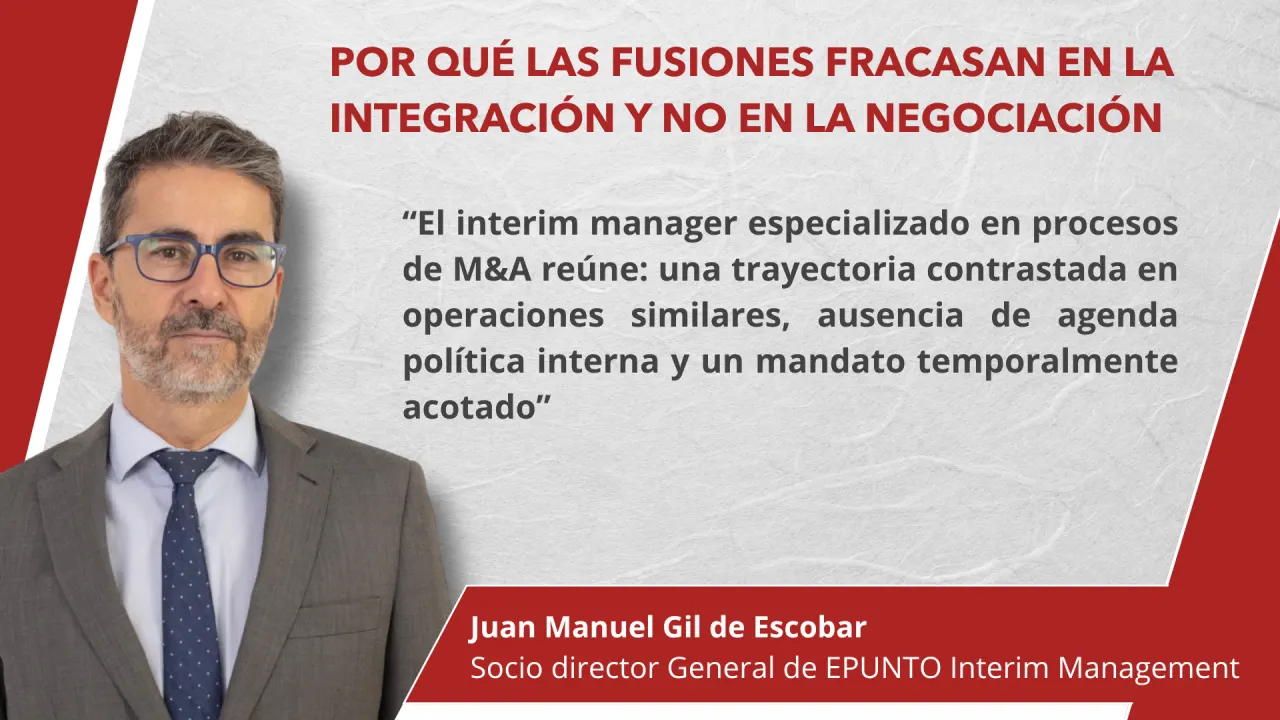
Why mergers fail at integration rather than at negotiation
The true success of an M&A transaction is not determined when the agreement is signed, but during the first 100 days of operational integration – a critical phase that requires transitional leadership with authority and free from political constraints.
The signing of an M&A deal is often seen as a moment of collective relief. Months of audits, valuations and negotiations culminate in an agreement which, on paper, makes perfect financial sense.
What happens next, however, is rarely factored into the models: integration. And it is there – not at the negotiating table – that it is decided whether the projected value will materialise or evaporate in the months that follow.
Experience gained from corporate transactions of varying scales and across different sectors points to a consistent conclusion: the price paid matters less than is commonly believed. An acquisition made at a reasonable multiple can destroy value for two consecutive years if the transition is not managed with the same discipline as was applied to the deal itself. And yet, the bulk of resources (management time, specialist talent, advisers’ fees) is almost systematically concentrated prior to closing.
What due diligence uncovers and the integration plan fails to address
It is worth dispelling a common misconception that the problem lies not in due diligence failing to identify integration risks. A well-executed operational due diligence identifies these risks with remarkable precision: incompatible ERP systems; client contracts containing change-of-control clauses; collective agreements that cannot be merged without labour disputes; and executives whose continued employment depends on specific conditions of which the buyer is unaware. The real problem lies elsewhere: this knowledge is rarely incorporated into the integration plan with the same rigour with which the price is negotiated.
The pattern repeats itself all too often. The due diligence report identifies a critical risk (a reliance on a single supplier, a concentration of customers, a technology gap); the buyer accepts it as a condition of the deal; and, once the transaction is completed, no one with real authority is given the assignment to resolve it. Nine months later, that latent risk has turned into a breach of contract or a service penalty. The problem was never one of information. It was one of accountability and execution.
The critical window of the first hundred days
Integration does not proceed at a constant pace. It has a phase of maximum opportunity (usually between 90 and 120 days after closing) during which the organisation is in an exceptional state of receptiveness to change. Hierarchical structures are not yet consolidated, processes are being questioned and people are, to a greater or lesser extent, willing to adapt. This collective unease, if well managed, is the only time when certain decisions can be taken without the political cost they would entail six months later.
Anyone who fails to make the most of this window of opportunity to define which management structure will prevail, which systems will be retained and what culture will be built will not be in a better position to do so later. The organisation will make those decisions on its own, through the course of events, and, almost invariably, in a direction that preserves the previous status quo rather than building a new one.
Three specific phenomena erode value during this phase, and all three are entirely predictable:
- The conflict at middle management level: Whilst senior management manages the public narrative of the merger, it is the business unit heads and team leaders who, in practice, decide which processes are adopted and which are blocked. Without a clear role in the new organisational structure, they tend to protect their previous position with considerable skill.
- The departure of unaccounted-for talent: High-performing professionals do not wait for the uncertainty to be resolved. They assess their options quickly and act on them. Their departure does not appear on any dashboard for weeks, until a client reports that their usual point of contact no longer works for the company.
- Paralysis caused by dual governance: When two hierarchical structures coexist without a well-defined model of authority, any decision requires approval from both sides. What used to be resolved in a day is now delayed for three weeks. Operations suffer, clients notice the dysfunction, and the quarter’s results begin to diverge from the synergy model presented to the board.
Transitional leadership: the factor that plans fail to account for
A rigorous integration plan without a leader with real authority to execute it is of limited use. The question is not whether a plan exists (it almost always does) but who is leading it, with what assignment, and with what capacity to make difficult decisions without their position within the organisation being compromised as a result.
The profile required for this phase differs substantially from that of an executive managing under normal circumstances. It requires someone who has been through previous integrations, who recognises operational bottlenecks before they escalate, and who can liaise with the acquired company’s Management Committee with the authority that comes from experience, not formal hierarchy. And who can do so without being burdened by the internal dynamics that influence the decisions of the permanent management team.
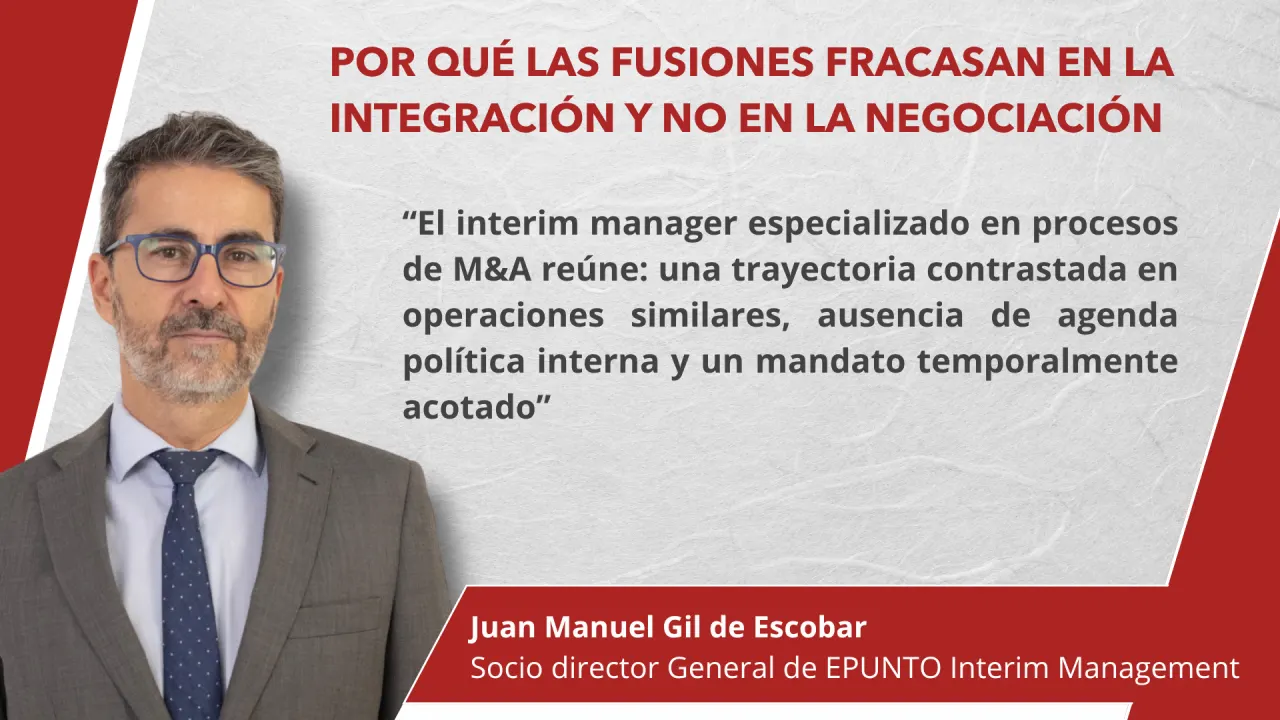
An interim manager specialising in M&A processes meets precisely these criteria: a proven track record in similar transactions, the absence of an internal political agenda, and a time-limited assignment that enables them to take decisions which the permanent management cannot take without incurring a long-term relational cost.
It is this combination (operational judgement, structural neutrality and a clear executive assignment) that makes it possible to shorten decision-making times at a stage where every week’s delay carries a measurable cost.