Cultural integration in M&A: The factor that financial models fail to measure, yet which determines the outcome
Financial due diligence is not enough to ensure success in mergers and acquisitions. Assessing cultural fit and managing talent through transitional leadership during the first 100 days is vital for retaining value.
In mergers and acquisitions (M&A), financial due diligence is an unavoidable, rigorous and absolutely essential step in assessing the viability of the transaction. However, a look at the market reveals that many mergers which promised significant synergies ultimately fail in practice. The answer to this paradox is often to be found in the most critical and least quantifiable aspect of any company: its organisational culture.
At EPUNTO Interim Management, we see on a daily basis how transactions stall not due to a lack of capital, but because of friction in people management. As Rafael Bustamante Schneider, a partner at EPUNTO, explains, “it is now very important to rethink integration and change management within organisations, particularly when private equity firms and funds acquire several companies with a view to integrating them”.
“A great deal of value and time is often wasted simply searching for data and financial results, when the real potential usually lies in all the other units that make up the companies” — Rafael Bustamante Schneider
It is precisely in these cases that the finance director is the most sought-after professional: “The CFO is the first piece of the jigsaw,” emphasises Rafael Bustamante. However, when it comes to the supply chain, production, manufacturing and marketing, “the priority must be to optimise the talent directly related to people; and we must get them to work together towards a common goal”. In this regard, “a great deal of value and time is often wasted simply searching for data and financial results, when in reality the greatest potential usually lies in all the other departments that make up the company”.
How to assess compatibility before closing the deal
Financial due diligence is insufficient unless accompanied by thorough cultural due diligence. Before signing off on the transaction, it is vital that your team looks beyond the balance sheets.
To this end, it is advisable to rigorously assess three key aspects:
- Mapping the decision-making process: You must be able to determine whether you are dealing with a hierarchical and bureaucratic company or an agile and decentralised structure. Methodological clashes on this point bring operations to a standstill almost immediately.
- Identifying hidden talent: Beyond the official organisation chart that is presented, you must discover who the informal leaders are who truly drive and inspire the teams.
- Communication styles: It is very important to assess accurately whether the acquired company promotes internal transparency or, conversely, whether its departments communicate with one another in isolation.
The first 100 days: the critical period for retaining talent
During the first 100 days following the acquisition, uncertainty becomes the greatest enemy of retaining key talent. To mitigate this risk, a proper integration strategy must be built on transparent communication. Employees need to know their place within the new structure as soon as possible so they can refocus on productivity.
Transition leadership
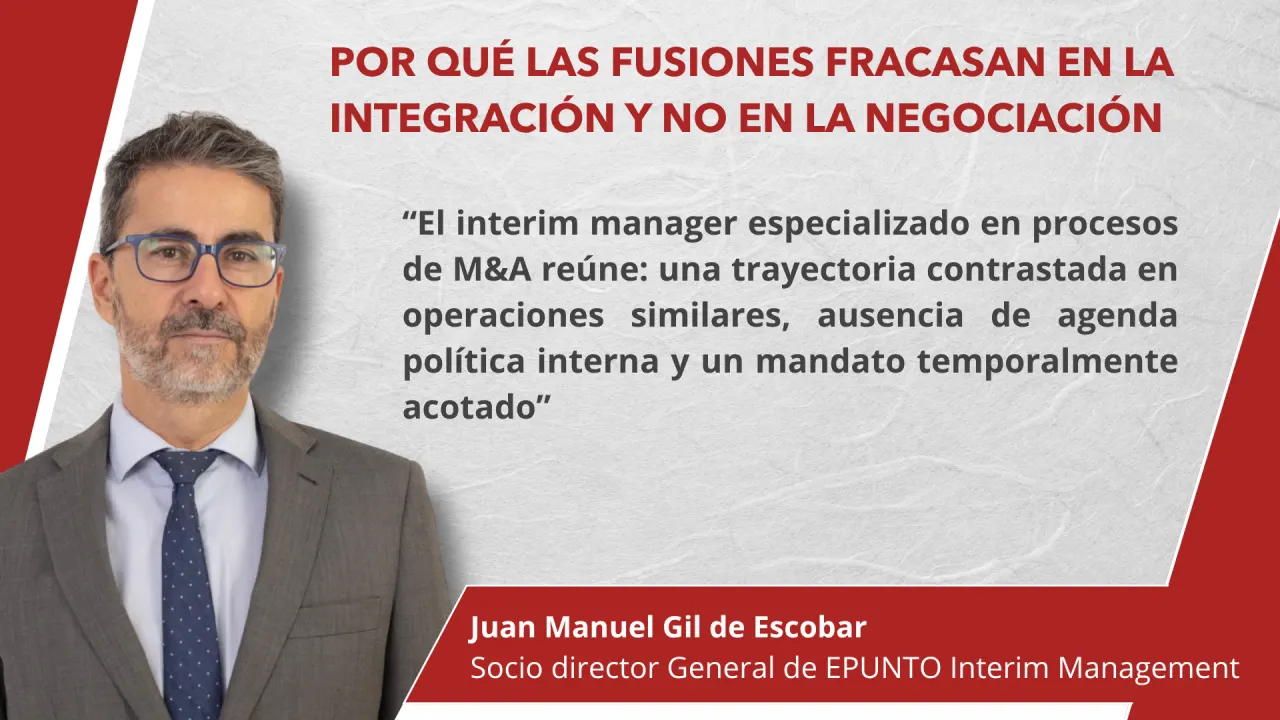
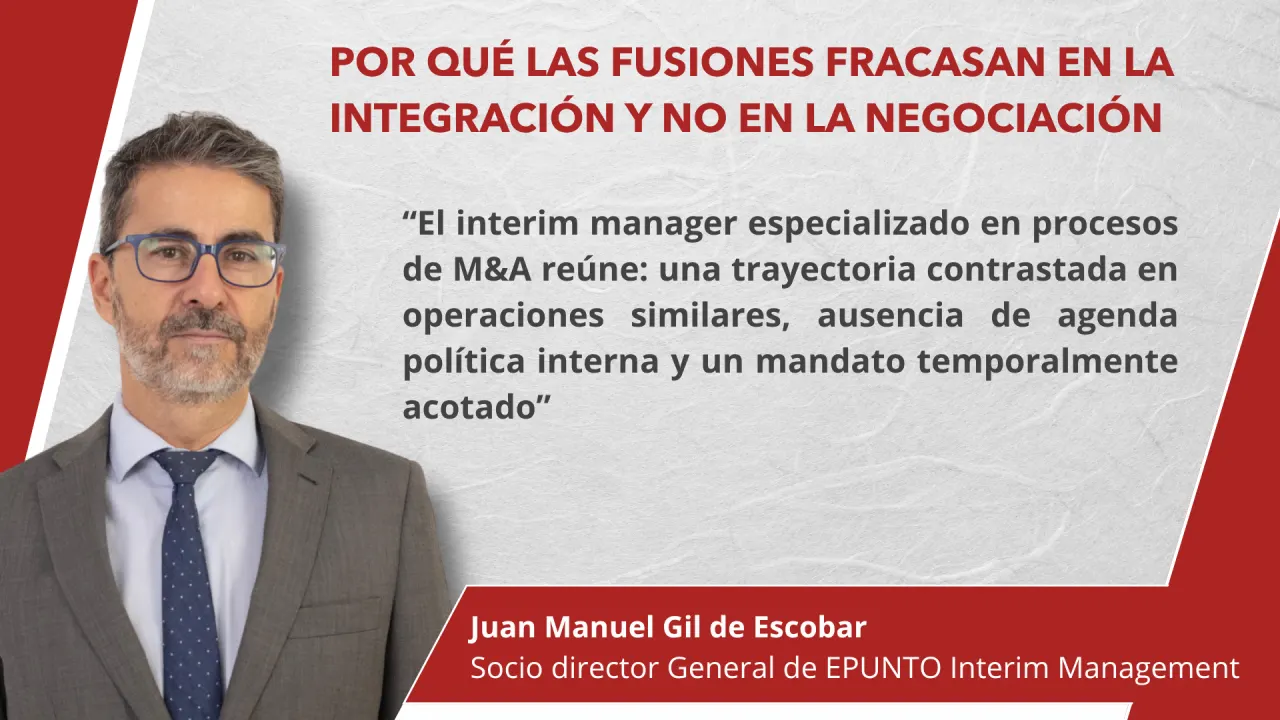
It is also essential to ensure that cross-organisational objectives are aligned. Creating mixed teams for projects requiring rapid execution demonstrates to the workforce that both parties contribute value to the new entity. At this stage, transitional leadership takes on particular importance. Bringing in external, independent figures, such as an interim manager specialising in change management, provides the company with the objectivity needed to align processes without being influenced by the biases or loyalties of the previous corporate culture.
Integration is not simply a matter of assessing and assimilating the acquired entity. It involves building and consolidating a new culture capable of strategically harnessing the best of both sides.
If you are currently involved in an M&A process or plan to be in the near future, we invite you to reflect on the importance your organisation is placing on cultural integration.
Here at EPUNTO Interim Management, we stand ready to support you and ensure success in this crucial challenge.