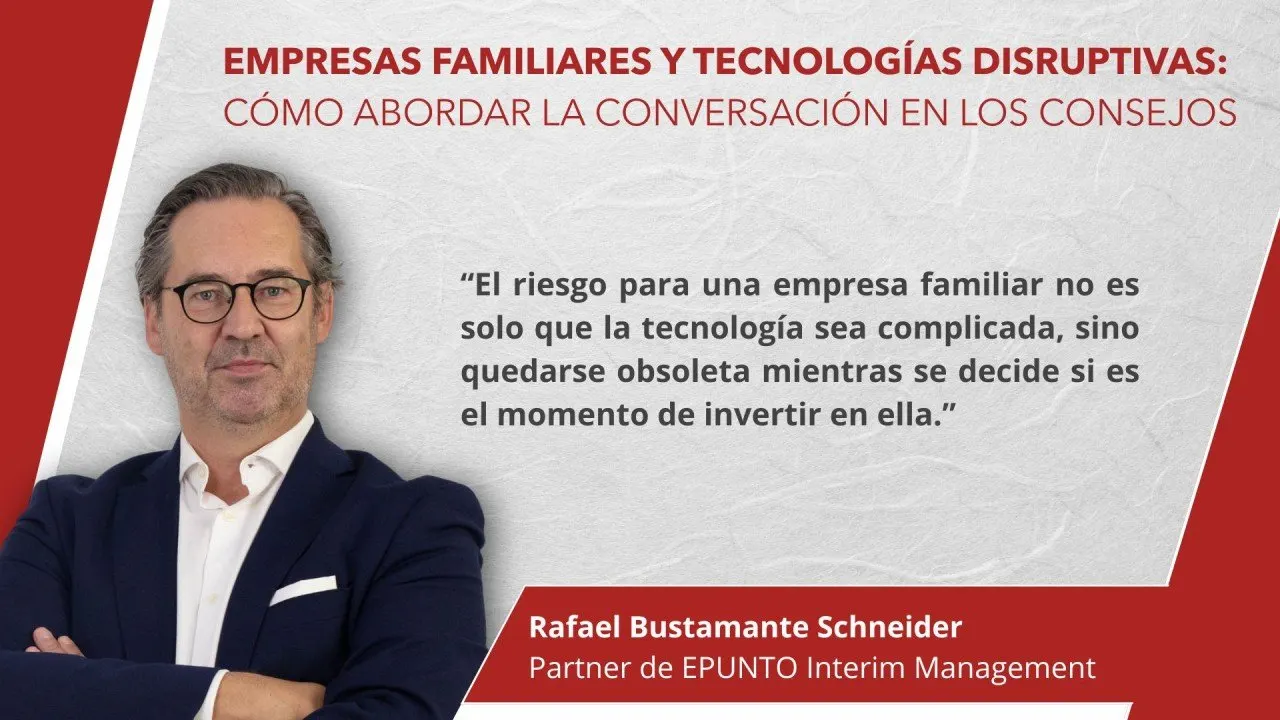
Family businesses and disruptive technologies: how to broach the subject at the Board of Directors
Artificial intelligence is no longer merely a technological option but has become a factor in business survival. The Board of Directors must lead its strategic adoption, drawing on interim executives to ensure a smooth transition.
At family business meetings, there are many recurring topics: generational succession, expansion into new markets, and the quarterly results. However, artificial intelligence and process automation have begun to feature prominently on the agenda in recent years.
These are no longer the stuff of science fiction or topics exclusive to the IT department. They are factors that will determine whether the business remains competitive over the next five years.
Understanding artificial intelligence without the technical jargon
Based on EPUNTO Interim Management’s experience in supporting governing bodies, it is clear that the challenge is not technical, but strategic. The Board of Directors does not need to know how to programme an algorithm, but it must understand how this technology can transform their sector before an external competitor does so for them.
How technology has gone from being an expense to ensuring survival
It is common for family businesses to place great value on prudence. Indeed, such caution has helped many companies weather crises, but with AI, the pace is different. Disruption strikes without warning. Nowadays, tools such as AI agents or the automation of certain processes can enable a small business to perform almost as well as a multinational, drastically reducing costs and response times.
The risk for a family business is not just that technology is complicated, but that it becomes obsolete whilst the decision is being made as to whether it is the right time to invest in it. That is why the board must lead this conversation with an open mind: technology is not there to replace the family legacy, but to provide the tools needed to ensure that legacy continues.
The role of the Board: asking the right questions
The role of senior management is to look beyond day-to-day operations and anticipate the future. Rather than debating which software to buy, the discussion should focus on how digitalisation affects the company’s value proposition.
To tackle this conversation properly at the next board meeting, here are some of the key questions that should be put on the table:
1. Is our data ready for use?
AI thrives on information. If the company’s data is scattered, poorly organised or incomplete, any investment in technology will be inefficient. Do we know what information we have and how to make the most of it?
2. Which low-value tasks can we delegate to AI agents?
We are no longer talking about simple automated responses. AI agents can manage orders, handle incidents or analyse risks autonomously. In which areas are we wasting our staff’s time on tasks that a machine would do better?
3. How are we going to support our team through this change?
In a family business, the team is often part of the ‘extended family’. It is vital to discuss how employees will be trained to use AI to their advantage, allaying fears of being replaced and enhancing their talents.
AI agents: beyond automated responses
One of the concepts that is most radically changing the game is that of AI agents. Unlike a traditional programme that merely follows fixed instructions, an agent has a certain capacity to make decisions and carry out complete tasks.
For the Board of Directors, this means that the company’s operating structures can become much more agile. Imagine a system that not only alerts you when stock is running low, but also negotiates with three suppliers, selects the best offer based on quality records, and prepares the order for approval. This isn’t the future; it’s already happening. Family businesses that adopt these solutions will reach a cruising speed that was previously only within the reach of tech giants.
The interim manager as an ally in the transition
Sometimes, board members know they need to take the plunge, but do not want to overburden the internal structure or fear making the wrong choice of technology. This is where the role of the interim manager brings real value.
The idea is to bring in an experienced executive who joins the organisation with a clear objective: to implement the technology strategy decided upon by the board. They are not a consultant who leaves a report and walks away; they are a professional who “rolls up their sleeves”, understands the family’s culture and ensures that the digital transition is carried out in an orderly, cost-effective manner without losing sight of the essence of the business. Their external perspective, therefore, helps to overcome internal resistance and bring objectivity to decisions that are sometimes overly emotionally charged.
Now is the time to speak up
Disruptive technology need not be a threat. If approached by the board with curiosity and strategic vision, it becomes the best ally for generational continuity.