The 16 situations that interim management addresses in the current crisis
Scenarios in which companies may require an interim management service during the current crisis. These are the 16 scenarios and situations in which companies may require an interim management service during the current crisis: 1 – Urgent replacements: Temporary replacement of a senior management position due to dismissal, resignation or sick leave […]
Situations in which companies may require an interim management service during the current crisis
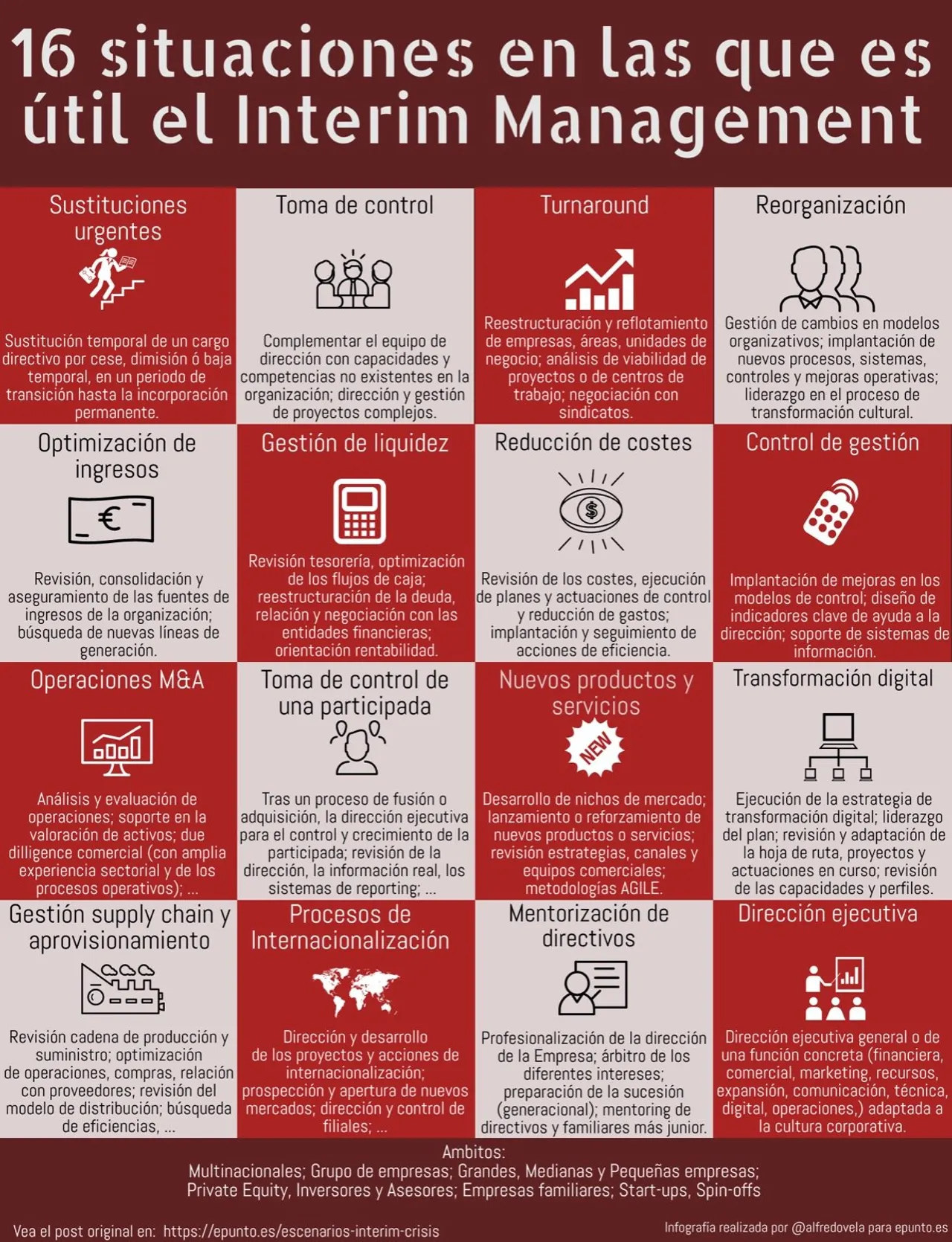
Here are the 16 scenarios and situations in which companies may need an interim management service during the current crisis:
1 – Urgent replacements
Temporary replacement of a senior management position due to dismissal, resignation or temporary absence, during a transitional period until a permanent appointment is made.
2 – Strengthening capabilities
Supplementing the management team with skills and expertise not currently available within the organisation; leadership and project management.
3 – Turnaround
Restructuring and revitalisation of companies, departments and business units; feasibility analysis of projects or worksites; negotiation with trade unions.
4 – Reorganisation
Managing changes to organisational models; implementation of new processes, systems, controls and operational improvements; leadership in the cultural transformation process.
5 – Revenue optimisation
Review, consolidation and safeguarding of the organisation’s revenue streams; identification of new revenue streams.
6 – Liquidity management
Review of treasury management and optimisation of cash flows; debt restructuring, liaising with and negotiating with financial institutions; focus on profitability.
7 – Cost reduction
Reviewing costs; implementing plans and measures to control and reduce expenditure; introducing and monitoring efficiency measures.
8 – Management control
Implementation of improvements to control models; design of key performance indicators to support management; support for information systems.
9 – M&A operations
Analysis and evaluation of transactions; support with asset valuation; commercial due diligence (with extensive sector-specific and operational process expertise); support throughout the negotiation process; business integration and divestment.
10 – Taking control of a portfolio company
Following a merger or acquisition, providing executive management to ensure the control and growth of the investee; review of management, actual performance data and reporting systems; alignment with the buyer’s agenda.
11 – New products and services
Development of niche markets; launch or strengthening of new products or services; review of strategies, channels and sales teams; implementation of new sales methodologies (AGILE)
12 – Digital transformation
Execution of the digital transformation strategy; leadership of the plan; review and adaptation of the roadmap, projects and ongoing initiatives; review of capabilities and profiles.
13 – Supply chain and procurement management
Review of the production and supply chain; optimisation of operations, procurement and supplier relationships; review and update of the distribution model; pursuit of efficiencies, and increased productivity and automation.
14 – Internationalisation Processes
Management and development of internationalisation projects and initiatives; prospecting for and entering new markets; management and oversight of subsidiaries; reviewing the viability of operations in unprofitable countries
15 – Executive mentoring
Professionalisation of the company’s management; mediating between different interests; preparing for (generational) succession; mentoring of more junior executives and family members
16 – Executive Management
Executive management or management of a specific function (finance, sales, marketing, human resources, expansion, communications, technical, digital, operations) tailored to the corporate culture and specific needs
The areas of application are:
Multinationals; Groups of companies; Large and medium-sized enterprises; Private equity firms, investors and advisers; Family-owned businesses; Start-ups and spin-offs.