“Digitalisation is 10 per cent technology, 40 per cent data and 50 per cent philosophy and methodology”
Emilio del Prado is a Managing Partner at EPUNTO Interim Management and a specialist in digital transformation processes, a role he fulfils as CEO of LIQUID Smart Technologies. In this interview, this dynamic and versatile entrepreneur – an engineer by profession with extensive experience in the ICT sector – discusses the key factors that establish the link between management […]
Emilio del Prado is a Managing Partner at EPUNTO Interim Management and a specialist in digital transformation processes, a role he fulfils as CEO of LIQUID Smart Technologies. In this interview, this dynamic and multi-talented entrepreneur – an engineer by profession with extensive experience in the ICT sector – discusses the key factors linking interim management and digitalisation.
Madrid, 25 April 2022
EPUNTO Interim Management prides itself on being the company in the sector with the greatest capacity to deliver projects linked to digital transformation. What is the reason for this, and what are the advantages of interim management over conventional management for this type of project?
In terms of priorities, the implementation of digital transformation strategies – if I may briefly refer to this as ‘digitalisation’ – consists of 10 per cent technology, 40 per cent data and 50 per cent philosophy and methodology. Consequently, digitalisation currently faces a number of risks and obstacles that are proportionate to the priorities mentioned above, and these are primarily addressed through management activities. However, it has been demonstrated that conventional management is less effective than transitional management, which is designed to introduce new philosophies and working methods – something that digital disruption demands.
What is LIQUID Smart Technologies and how is it linked to EPUNTO Interim Management?
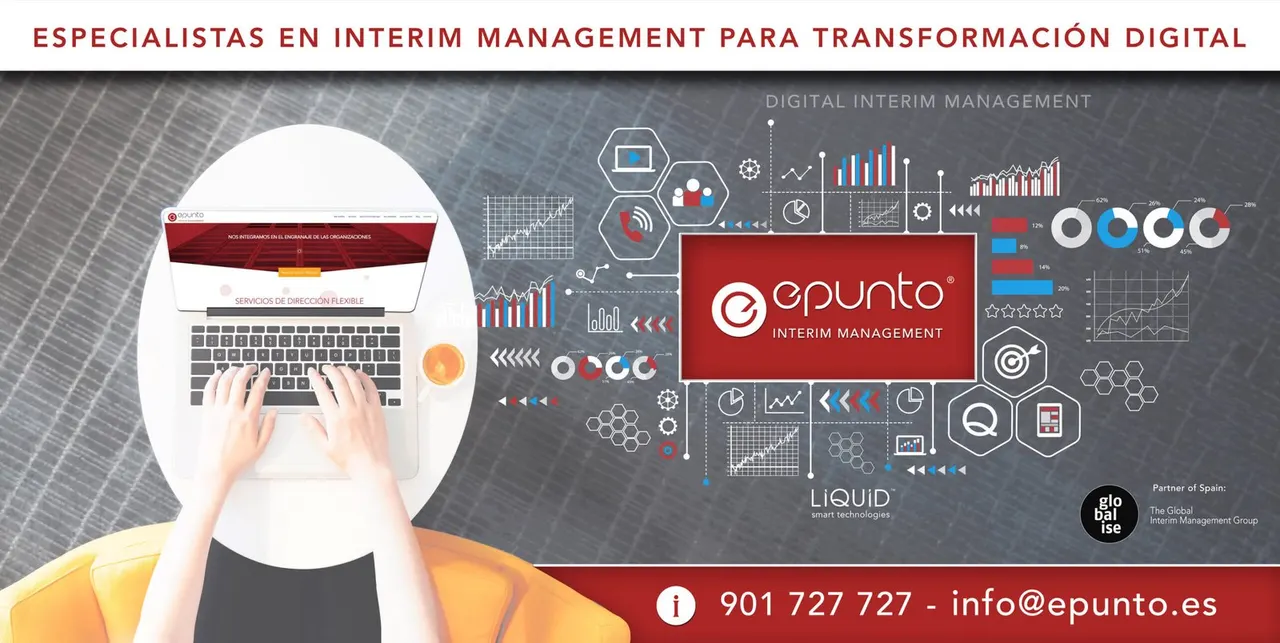
LIQUID Smart Technologies is a technology consultancy firm that emerged as a spin-off from EPUNTO Interim Management. Its aim is to meet the digitalisation needs of businesses and public bodies, complementing EPUNTO’s transitional management services. Furthermore, LIQUID offers talent management based on relationships with top-tier independent professionals, thereby addressing current challenges in the sector, such as staff turnover, a lack of engagement and a shortage of professionals.
In this way, we provide a more comprehensive and integrated solution. On the one hand, we manage digitalisation projects (EPUNTO) through transition management; on the other, we carry out the associated technical activities (LIQUID). All of this is delivered by highly specialised professionals to ensure effectiveness, and they are assigned on a temporary and flexible basis, thereby guaranteeing maximum efficiency.
The Next Generation EU funds from the ‘European Economic Recovery Fund’, totalling €140,000 million, will allocate a significant portion to digital transformation. Are these funds reaching Spanish companies, and are they making the most of them?
It is still too early to draw conclusions, as the various funding schemes for digitalisation, drawn from Next Generation funds, are only just beginning to be launched. The Kit Digital programme, for example, with a budget of over 3,000 million euros – the largest digitalisation initiative for SMEs and the self-employed in Spain’s history – was launched last March and has seen a massive influx of applications; more than 50,000 in a month, according to the Prime Minister’s Office. Now all that remains is for these SMEs to engage accredited digitalisation providers, such as LIQUID Smart Technologies, to use the funds to implement digitalisation solutions.
Combining interim management with the Agile philosophy seems to be a competitive approach to project management, extending beyond projects linked to digital transformation. What does it involve and how is it applied from the perspective of interim management?
It is undoubtedly the perfect combination. The AGILE philosophy is, essentially, flexibility in working methods, whilst interim management represents flexibility at management level. AGILE consists of combining Scrum (the most widely used Agile framework) with their management by interim managers, acting in both the roles of Scrum Master and Product Owner. This completely relieves the client of the burden of executing the transformation whilst allowing them to maintain a position in terms of making strategic decisions and monitoring results.
What sort of organisations are seeking interim management services to carry out digital transformation projects, and what do they find when the intervention begins?
Transition management services applicable to digitalisation are used in medium-sized and large-scale projects, as the impact on results must offset the cost of the service itself, and the risk of failure must be minimised through effective project management.
The organisations launching these projects are usually medium-sized or large, but we may also encounter small businesses or recently established start-ups that are undertaking ambitious projects by turning to interim management to minimise the risks of a negative impact on results.
Is the public sector one of the target markets for EPUNTO Interim Management and LIQUID Smart Technologies in the field of digital transformation?
The public sector’s procurement practices – which are inflexible and prioritise budget over results and specialisation – currently make it very difficult for them to take advantage of our value proposition.
However, for projects that were initiated using conventional methods and have taken a turn for the worse due to their complexity, there are few better solutions than the combined value proposition of EPUNTO Interim Management and LIQUID Smart Technologies; a genuine winning formula.
Finally, EPUNTO Interim Management is part of the international GLOBALISE Alliance and serves clients on every continent. Are you carrying out digital transformation projects in other countries or only in Spain?
We are currently carrying out digitalisation projects for international clients in Europe and the Americas. The technology sector is global in nature; connections are transnational and teams are spread across the globe. For us, our clients’ location is irrelevant as this does not affect our working methods, except in matters relating to regulations, which we resolve by using technological infrastructure physically located within the European Union.