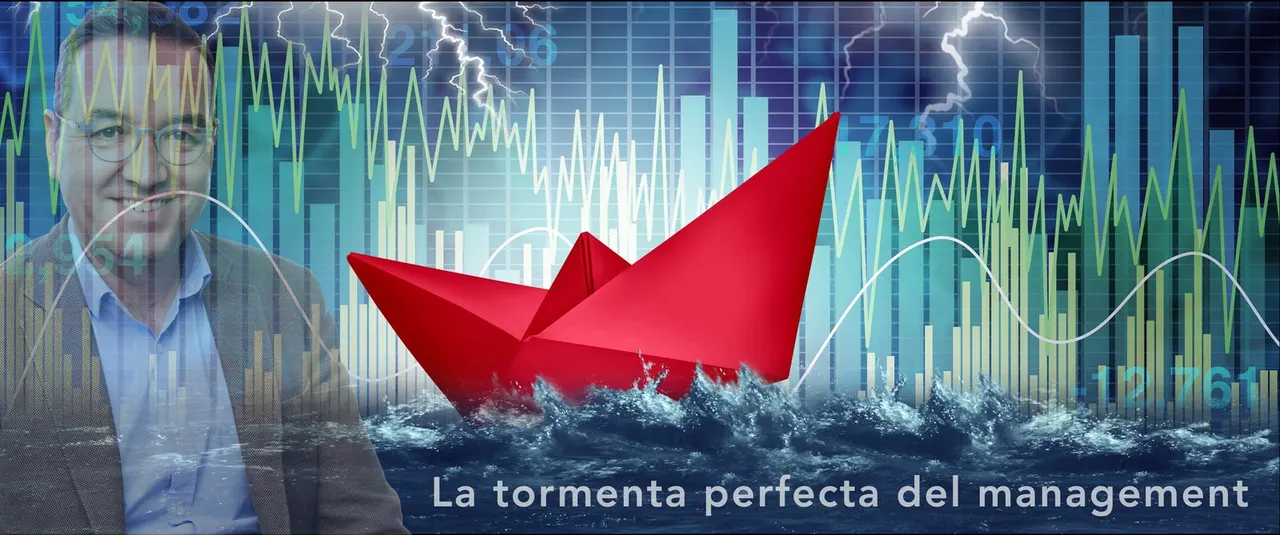
‘The perfect storm in management’
Business management (what we call ‘management’), like other activities, is undergoing a profound transformation in the current climate. This statement is yet another truism in the current climate, characterised by rapid and radical changes; however, analysing it is not quite so straightforward. Madrid, 29 June 2023. At the moment […]
Business management (what we call ‘management’), like other activities, is undergoing profound change in the current climate. This statement is yet another truism in the current context, characterised by rapid and radical changes; however, analysing it is not quite so straightforward.
Madrid, 29 June 2023
At this moment in time, marked by great confusion and a lack of focus in management, a good starting point for getting back on the right track is to turn to business axioms – the basic strategic principles which, amidst the whirlwind of change, remain unchanged. An example would be:
“…our companies aim to meet demand by marketing products or services at a selling price higher than their cost, seeking organic or inorganic growth”
These are axioms and do not need to be proven, nor are they open to debate. They are management mantras to which, of course, sustainability criteria (ESG criteria) are added.
The objectives that any organisation sets for management professionals are based on the implementation of the above axioms or variations thereof. This is where things start to get complicated, as changes in management are more complex and far-reaching than in other ‘professions’. The reason is that three factors have converged to create the perfect storm:
Firstly, the digital revolution, which is disrupting the traditional management of resources and knowledge available to managers for decision-making.
Secondly, the explosion of artificial intelligence, which is linked to the first, but carries with it a set of ethical and philosophical nuances of enormous complexity.
Finally, the massive social change in the labour market, which directly impacts management’s primary and most complex activity: leading people to achieve the assigned objective together.
These three ingredients that make up the ‘perfect storm’ of management also entail a complete overhaul of the traditional concept, which is based on attributes such as ‘filling a post’ rather than ‘leading a project’, a ‘permanent’ nature rather than ‘limiting it in time’, ‘maintaining the status quo’ rather than ‘transforming an organisation’.
Management today does not seek to fill a post. It must be understood as the execution of an assigned strategy, channelled through a management project with specific objectives and commitments.
Modern management is not permanent in nature because the failure to renew challenges and commitments inevitably leads to a loss of effectiveness and demotivation amongst management professionals.
Modern management must not simply go along with organisational inertia; on the contrary, it must be the primary agent of transformation. It must lead change by skilfully navigating through storms, utilising the resources at its disposal and leading teams to steer the organisation towards calmer waters. Other storms will come, and new challenges will arise that need to be resolved.
EPUNTO Interim Management, as a firm specialising in management services, responds to this new reality by naturally and structurally incorporating the various elements of modern management into its service delivery methodology, thereby mitigating potential risks through the guarantees offered to clients.
For this reason, our management services are at the forefront of this new reality, as they adapt flexibly to the management needs of organisations. We draw on the best management professionals available on the market, supervised by our partners who have overseen hundreds of projects.
Founder and Managing Partner of EPUNTO Interim Management.