
Emilio del Prado and ‘Temporary Hiring of Executives’
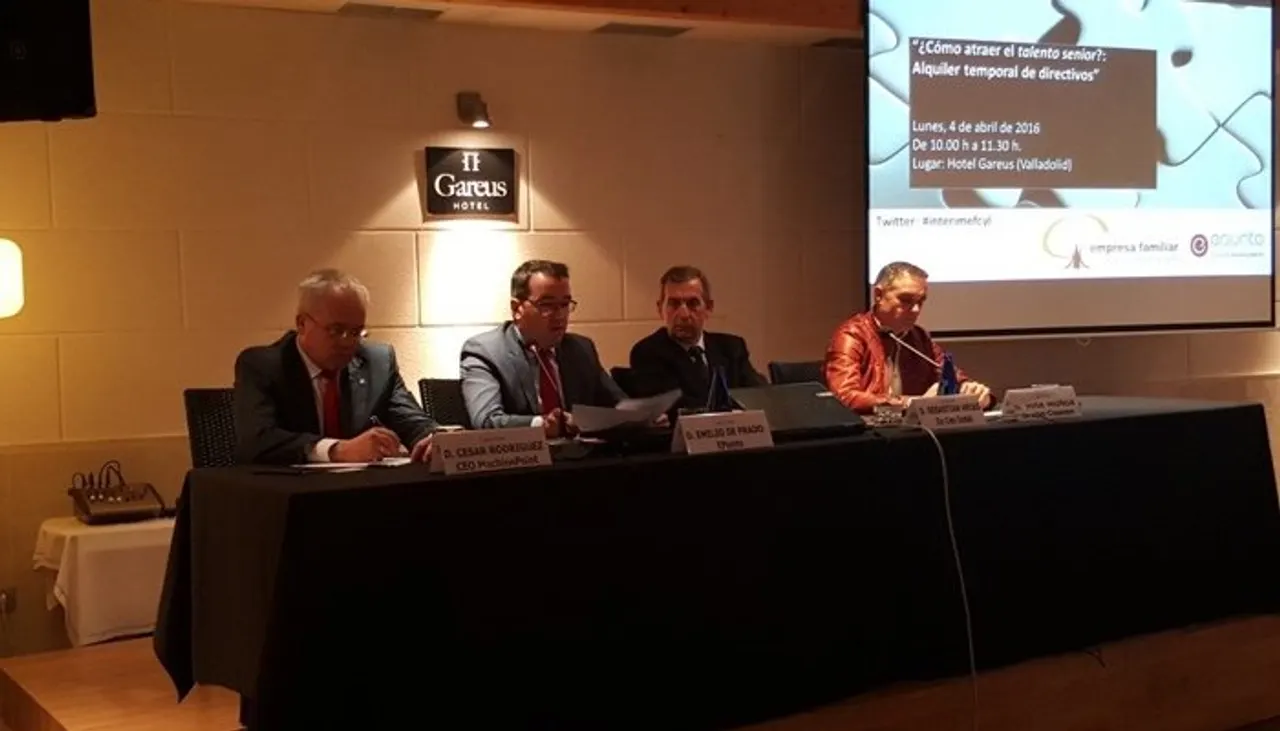
How to attract senior talent?: Temporary executive secondment. As we announced in a previous post, Empresa Familiar Castilla y León organised the conference: “How to attract senior talent?: Temporary executive placements”. Guests included the likes of José Muñoz, Managing Director of Grupo Copese; Sebastián Arias, former CEO of Indal; and César Rodriguez, CEO of […]
How to attract senior talent?: Temporary executive placements.
As we announced in a previous post, Empresa Familiar Castilla y León organised the conference: “How to attract senior talent?: Temporary executive placements”
Distinguished guests including José Muñoz, Managing Director of Grupo Copese; Sebastián Arias, former CEO of Indal; and César Rodriguez, CEO of MachinePoint; presented the case studies that led their companies to achieve success at specific points in time, thanks to the appointment of an Interim Manager. Emilio del Prado – Managing Partner at EPUNTO Interim Management – moderated the round-table discussion, which covered, amongst other things, the duration and cost of this type of service.
Emilio del Prado’s full speech, which clearly summarised this often-misunderstood role:
‘Allow me to take a few moments to introduce the concept we are discussing at today’s working breakfast. When a temporary situation arising within our own organisation keeps us awake at night, we find ourselves faced with two opposing choices: either we resolve the situation using our own internal resources, or we must seek external help.
We obviously opt for the first option when we can: when we have a colleague within the organisation whom we trust completely to successfully carry out the tasks needed to resolve the situation. Sometimes – very often, in fact – that colleague is ourselves…
But if we choose to seek external help, we are faced with a wide range of options to suit all tastes, preferences and budgets, each approaching the solution from a different angle. Choosing one external option over another ceases to be a matter of trust and enters the realm of faith.
Allow me, given the difficulty this entails, to classify this external help into four types:
- The first type is to hire a consultancy. The consultant, with their methodology, expertise and insight, helps us see the light and lays the solution out before our eyes; yet, returning to the root of our decision, we lack the internal resources to implement it, however appealing it may be.
- The second type is to commission training. Training in the various strategic, operational and technical aspects that enable us to resolve the transitional situation internally, retaining the knowledge within the organisation and generating an intangible asset that prepares us to successfully tackle other future scenarios. If our organisation can afford to wait for the training content to take root and translate into concrete, successful actions, training is undoubtedly an excellent option.
We therefore have the option of commissioning consultancy and training.
- The third and fourth options, as you can imagine, are to recruit senior talent – either by hiring an executive on a permanent basis, or, conversely, by bringing in an executive only for as long as is necessary to resolve the situation at hand… and which is causing us concern.
The ‘buy or rent’ dilemma presents itself once again. Hiring an executive from outside the organisation on a permanent basis (i.e. ‘buying’) can be a far more complex undertaking than the quest for the Holy Grail. The fear of a failed decision, which would inevitably lead to a dismissal, grips us and paralyses our decision-making. When this is combined with the difficulty of attracting senior talent to our companies, the conclusion is that ‘Houston, we have a problem’.
For big problems, better solutions: hiring an executive for as long as it takes to resolve the situation allows us to attract – temporarily – that talent, keep our costs under control without making them permanent, and have access to top-level professionals who are tremendously enthusiastic about working with our company – something that, in a permanent scenario, would be much more difficult, time-consuming and sometimes costly.”