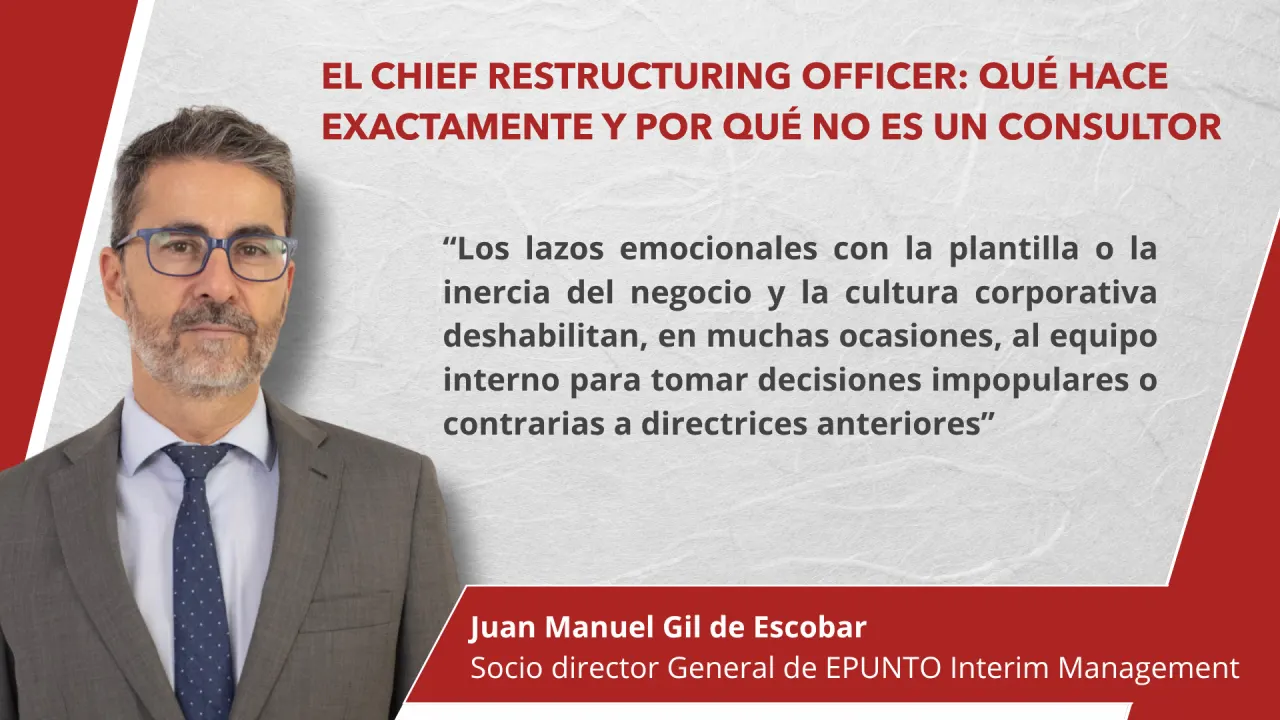
The Chief Restructuring Officer: what exactly do they do, and why aren’t they a consultant?
In times of crisis or financial stress, a company needs more than just advice. The Chief Restructuring Officer (CRO) takes direct operational control to stabilise cash flow and implement structural changes with complete independence.
When a company is facing financial stress or needs to undergo a fundamental transformation to ensure its viability, the first instinct is usually to seek external help. At this stage, it is common to turn to consultancy firms to assess the situation and propose a plan of action. However, in critical situations, simply knowing what to do is not enough. The real challenge lies in carrying it out.
This is where the role of the Chief Restructuring Officer (CRO) comes into play.
Advising versus executing: the key difference
The distinction between a consultant and a CRO is, fundamentally, a matter of role and executive responsibility. The consultant analyses the situation, identifies the problem and provides a strategic roadmap. Their work provides a valuable perspective, but their involvement ends where the reality of implementation begins. The CRO joins the executive structure on a temporary basis. They do not merely suggest a route, but take the organisation’s helm, their purpose being to assume real operational control in order to implement the measures from within.
Actual operational control: the CRO’s key responsibilities
A CRO’s intervention is conceptually surgical and focused on three critical areas for survival:
● Immediate cash flow stabilisation: The absolute priority in any crisis is to protect liquidity. The CRO takes charge of cash management, implementing urgent measures to stem the outflow of capital, freezing non-essential expenditure and optimising working capital to buy the necessary time.
● Direct negotiation with creditors: Rather than delegating this delicate task, the CRO takes the lead in discussions with banks, funds, suppliers and public authorities. Their presence brings authority, credibility and technical expertise – essential elements for restoring confidence and securing viable refinancing agreements.
● Implementing far-reaching structural changes: Redesigning the organisation requires making complex and unpopular decisions. This may involve divesting assets, closing business units that are draining profitability, or making severe operational adjustments. The CRO implements these measures with agility and resolve, ensuring that the resulting structure is sustainable.
Why is the internal team not always able to lead this process effectively?
It is natural for the current management or the founding team to feel the urge to lead the change themselves in order to turn the situation around. However, steering a complex restructuring requires a level of objectivity and detachment that is rarely present when one is immersed in day-to-day operations.
“Emotional ties to the workforce, or the inertia of the business and corporate culture, often prevent the internal team from taking unpopular decisions or those that run counter to previous guidelines” – Juan Manuel Gil De Escobar, Managing Partner at EPUNTO Interim Management
Emotional ties to the workforce, the inertia of the business and corporate culture, or the cumulative strain during the crisis often prevent the internal team from taking unpopular decisions or those contrary to previous guidelines. The CRO joins the company free from political ties, without inherited commitments and without fear of conflict. Their sole assignment is to protect the value of the company and its human capital, ensuring its continuity.
Furthermore, the Chief Restructuring Officer can bring highly specialised expertise. Whilst the usual management team is skilled at managing growth or day-to-day operations within the sector, the CRO is a specialist in crisis management and corporate rescue.
It is not a question of replacing talent, but of injecting a specific skill set that the company should not need on a permanent basis.
The executive solution through interim management
Bringing in a Chief Restructuring Officer is one of the clearest examples of the value of interim management. It is not about permanently expanding the executive payroll, but about integrating expert talent and the ability to deliver results for exactly as long as is required in extraordinary situations.
At EPUNTO Interim Management, we know that, in times of greatest uncertainty, organisations need not only theoretical assessments but also executive leadership, direct action and tangible results. Because the success of a restructuring depends not only on the report that is drawn up, but fundamentally on the decisions that are implemented.