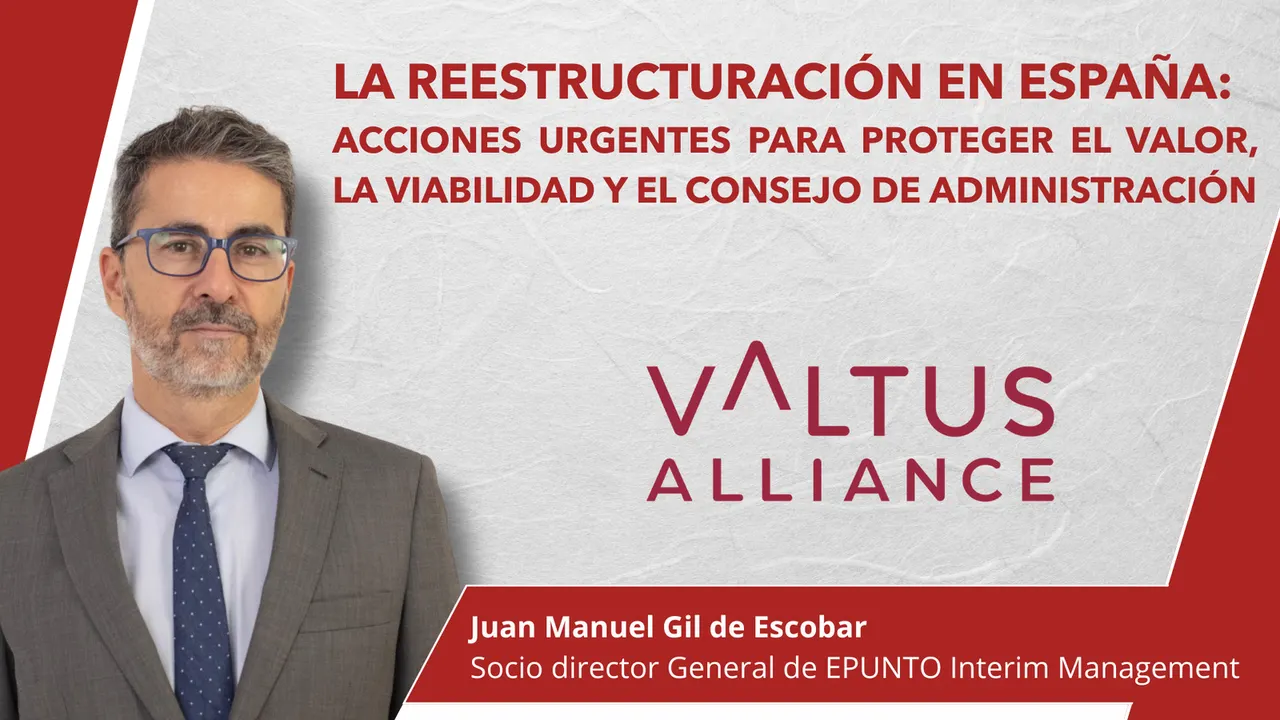
Restructuring in Spain: urgent measures to protect value, viability and the Board of Directors
At Valtus Alliance, we have an international network of restructuring experts, recognising that each country has its own legal framework and restructuring practices. In this interview, Ronald de Zoete, a Partner at Valpeo in Amsterdam, talks to Juan Manuel Gil de Escobar, Managing Partner at Epunto in Madrid, about how restructuring is approached […]
At Valtus Alliance, we have an international network of restructuring experts, recognising that each country has its own legal framework and restructuring practices. In this interview, Ronald de Zoete, a Partner at Valpeo in Amsterdam, talks to Juan Manuel Gil de Escobar, Managing Partner at Epunto in Madrid, about how restructuring is approached in Spain.
What makes the legal framework for insolvency and restructuring unique in Spain?
‘The most common and fatal mistake is denial, coupled with the attempt to resolve the crisis using the very same resources and methods that caused it. Boards of Directors and senior executives often rely on a miraculous market recovery that rarely materialises. They must understand that the likelihood of insolvency is not an optional rescue route, but a mandatory exercise in due diligence. Identifying it requires immediate action to protect the company’s viability and the legal certainty of the Board of Directors, although it remains an extremely difficult decision to make.”
At what point and in what capacity (e.g. consultant, finance director, risk manager) should an external restructuring expert be engaged?
“An expert should be engaged as soon as the likelihood of insolvency is detected, without undue delay. In medium- and large-cap companies, a traditional consultant is insufficient, as their role is limited to producing reports. The key figure is the interim restructuring manager, who acts as the Chief Restructuring Officer (CRO). This professional does not merely advise, but takes executive control of the restructuring, providing the necessary authority to implement drastic changes to both operations and the capital structure.”
What is your view on the use of protection proceedings as part of a restructuring strategy?
“In Spain, the restructuring plan is our main line of defence. However, if a high-calibre CRO is brought in well in advance, it is often possible to avoid the formal implementation of a court-supervised plan altogether. The viable timeframe provides a window which, when managed by experts, allows for a swift, private restructuring, turning the company round before the crisis becomes a matter of public record.”
Could you describe your local restructuring network? Who do you usually work with?
“At EPUNTO Interim Management, a member of the Valtus Alliance, we operate within an ecosystem of trusted interim managers – specialists in operations, finance and human resources with distinct CRO profiles. These are expert executives with practical experience, capable of stabilising cash flow within very short timeframes and leading complex negotiations. They frequently collaborate with leading commercial law firms to ensure that operational and legal strategies proceed in perfect synchrony.”