Private restructuring versus insolvency proceedings: when to take action to protect corporate reputation
Delaying structural decisions exacerbates any financial crisis. Taking proactive measures through a private restructuring led by an external expert helps to protect the company’s reputation and viability before the matter reaches the courts.
Insolvency proceedings do not destroy a company’s reputation on the day they are declared. They destroy it weeks or months beforehand, when the management already knew the problem was structural yet continued to run the business as if it were merely a temporary setback. That is the crucial distinction.
The difference between a well-executed private restructuring and insolvency proceedings is not merely legal or financial; it is, above all, a matter of time. And time, in these processes, is not neutral; it systematically works against those who delay taking action.
When does a problem cease to be a financial one and become one of reputation?
There are signs that management teams tend to dismiss as temporary: margins that are shrinking quarter on quarter, a recurring need to renegotiate payment terms with key suppliers, credit lines that are becoming increasingly difficult to renew, or cash flow that is now being managed on a week-by-week basis.
None of these signs, on its own, is definitive. But taken together – especially when they persist for more than two or three quarters – they indicate that the problem is no longer a one-off liquidity issue but has become a systemic one.
At that point, the reputational risk is already active, even if it is not yet visible. Suppliers talk amongst themselves, banks share information, and senior management start receiving calls. The window for acting discreetly exists, but it is closing faster than the financial statements suggest.
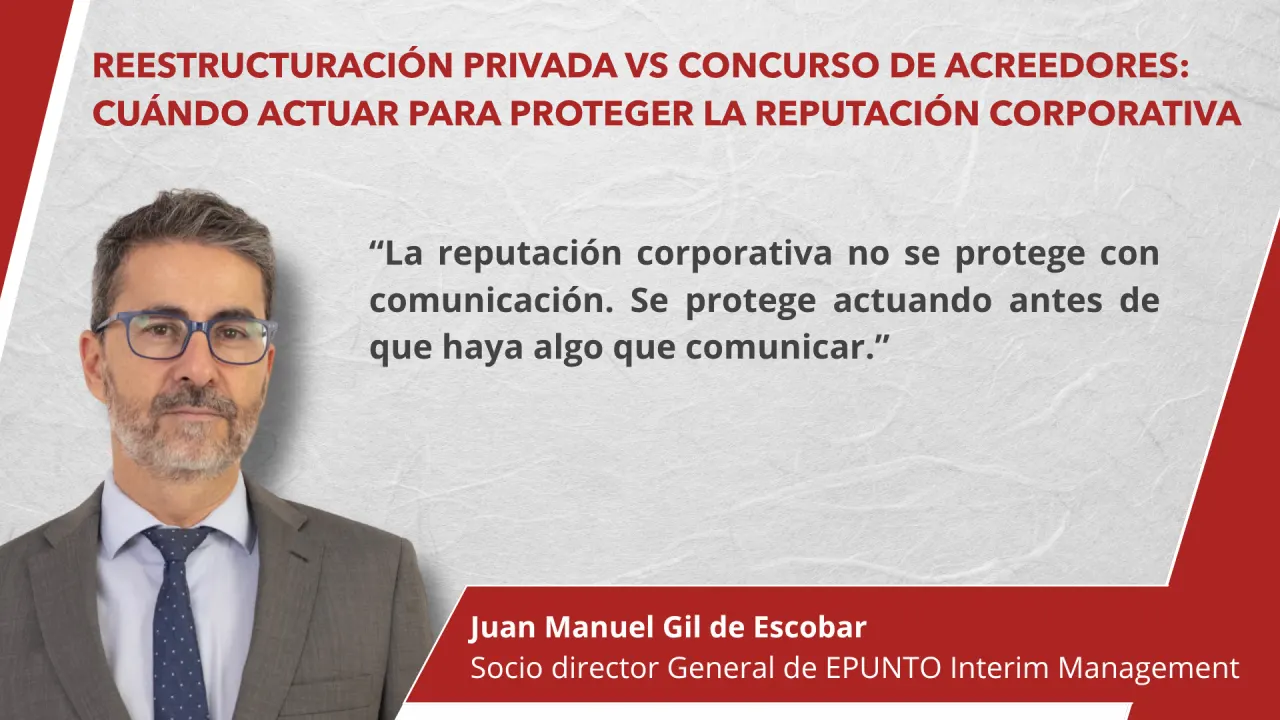
Corporate reputation is not protected through communication. It is protected by taking action before there is anything to communicate.
What the out-of-court route allows (and does not allow)
Private restructuring offers three real advantages over insolvency proceedings: confidentiality in negotiations, control over the narrative presented to stakeholders, and the absence of judicial stigma.
It is not a miracle cure, nor does it work in every situation. It requires a critical mass of creditors willing to negotiate, the underlying business to be genuinely viable, and, above all, sufficient financial headroom to sustain the process whilst negotiations are ongoing.
This last point is key and is often overlooked. Initiating an out-of-court restructuring when the company has only weeks, not months, of cash flow left turns the process into a negotiation under duress. Under such conditions, the terms imposed by creditors are substantially worse and management loses control of the process it sought to preserve.
The common mistake is not filing for insolvency, but failing to act in good time
The most common form of self-deception in these scenarios is to confuse the market problem with the company’s problem. The sector is struggling; we are in a downturn, and things will right themselves as soon as demand picks up. Such arguments may be partially true, yet still irrelevant if the cost structure, debt level or business model are not sustainable over the timeframe the market is willing to wait.
By the time management reaches that point of realisation, the optimal moment to act has long since passed. Not because there is no solution – there almost always is – but because the options are more costly, slower and carry greater risk.
The role of an external director in decision-making
One of the structural problems in situations of this kind is that those who must make the decision are the very same people who are most biased against making it. The team that has built the company, that knows its history and has maintained the optimism needed to operate in difficult environments, is also the least suited to making a dispassionate assessment of the situation.
An external executive, in the form of an interim manager with specific experience in restructuring, brings something that internal committees lack: an unbiased assessment. With no emotional ties to past decisions and no political exposure to previous results. This, combined with a clear executive assignment, enables the design and leadership of a credible viability plan – which is exactly what creditors need to see in order to negotiate.
If your company begins to detect signs that its financial model is faltering, this is the ideal time to explore private restructuring options. At EPUNTO Interim Management, we provide the managerial talent required to lead this process with complete confidentiality, safeguarding the future and reputation of your organisation.