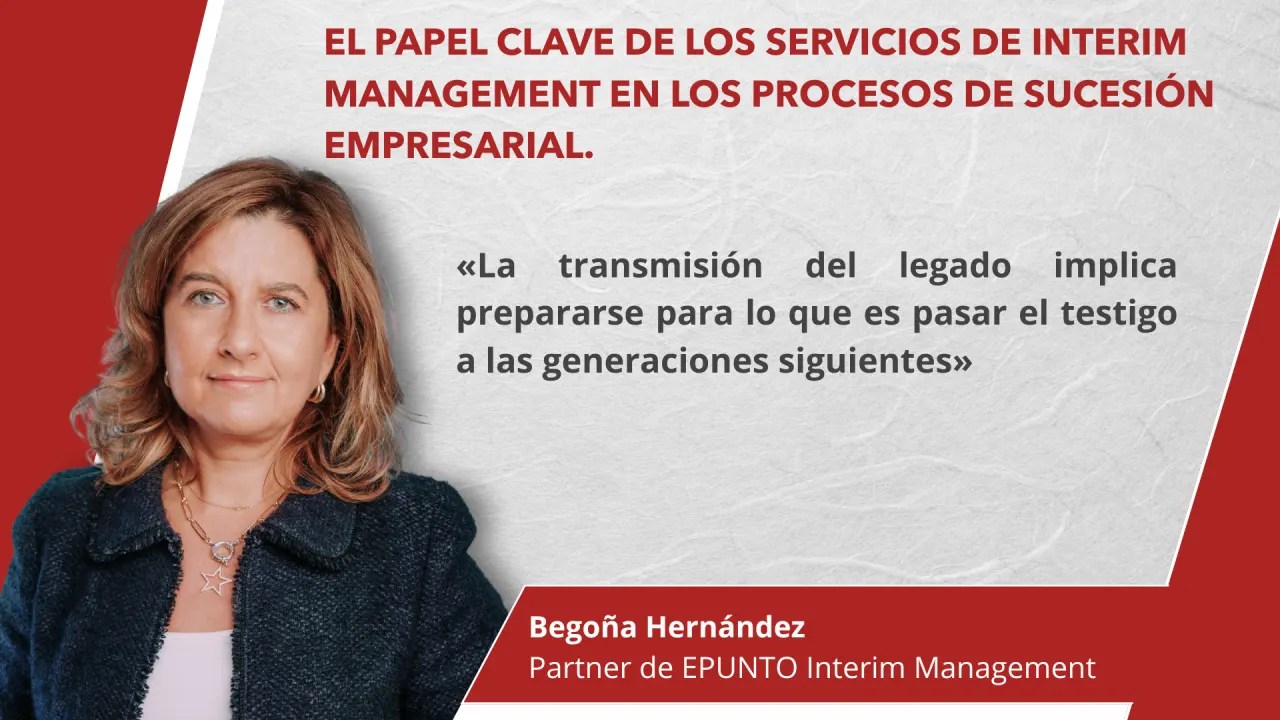
The key role of interim management services in business succession processes
Succession in a family business requires balancing respect for the legacy with practical decisions that ensure continuity. In this situation, bringing in temporary professionals who can provide immediate expertise, impartiality and a results-oriented approach can be of great help. Their involvement makes it easier to turn the intention to transfer the business into […]
Succession in a family business requires balancing respect for the legacy with practical decisions that ensure continuity. In this situation, bringing in temporary professionals who can provide immediate expertise, impartiality and a results-oriented approach can be of great assistance. Their involvement helps to transform the intention to transfer the business into an operational and measurable process, without the need to alter the company’s permanent structure.
Passing on the legacy involves preparing to hand the baton to the next generations.
Many family businesses face the tension inherent in succession: preserving values whilst, at the same time, ensuring the capabilities required by the transformation process demanded by changing times and defining any new phase.
An interim manager can help turn this transition into a professionalised process underpinned by specific tasks that ensure its success: assessing current skills, identifying critical gaps, designing learning pathways, and setting deadlines and metrics to monitor the progress of potential successors. In this way, continuity is addressed in practice, not merely in intention, and with an external perspective that can help to complement and broaden the owners’ strategic vision.
Support for professional development and training
In line with this approach, the role of the interim manager can play a significant part in supporting transition processes. The arrival of new generations or the growth of the family business must be accompanied by the professionalisation of management. The interim manager can contribute to this professionalisation by providing frameworks, analysis and objective evaluation criteria that enable family responsibilities to be separated from executive functions. Furthermore, they can collaborate on mentoring and coaching programmes aimed at developing both technical competencies and leadership skills, enabling the next generation of business leaders to take on roles with confidence and practical preparation.
It is also essential to professionalise certain areas of the company to prepare them for the future, equipping the company for the necessary cultural, digital and organisational transformation demanded by the times we live in, to ensure not only survival but also that it stands out from its competitive environment.
Interim management professionals can help where experience is lacking or where new areas of expertise are required, such as operations, technology or compliance.
An interim manager helps to implement proven practices, streamline procedures or draw up contingency plans. They also design a knowledge transfer process that ensures operational decisions become institutionalised within the company and do not depend on a single individual once their assignment ends.
Neutrality and support
Succession processes are complex, involving various parties; as a result, they can sometimes lead to complications, difficult decisions and impossible trade-offs… Consequently, the neutrality that characterises interim managers can provide support in tackling sensitive decisions using objective criteria. Their external position makes it easier to mediate in family disputes, oversee selection processes and propose the structure of governing bodies — such as the Board of Directors or independent committees — that professionalise decision-making. These structures reduce reliance on individual leadership and improve transparency during the transition.
An effective succession plan is not a one-off action, but a programme with phases, milestones and reviews. The temporary involvement of senior professionals accelerates professionalisation, reduces risks and leaves behind internal capabilities that endure.
In family businesses where the value of legacy and the desire for continuity are priorities, interim management is emerging as a practical tool for turning the handover into an objectively managed, verifiable and sustainable process.