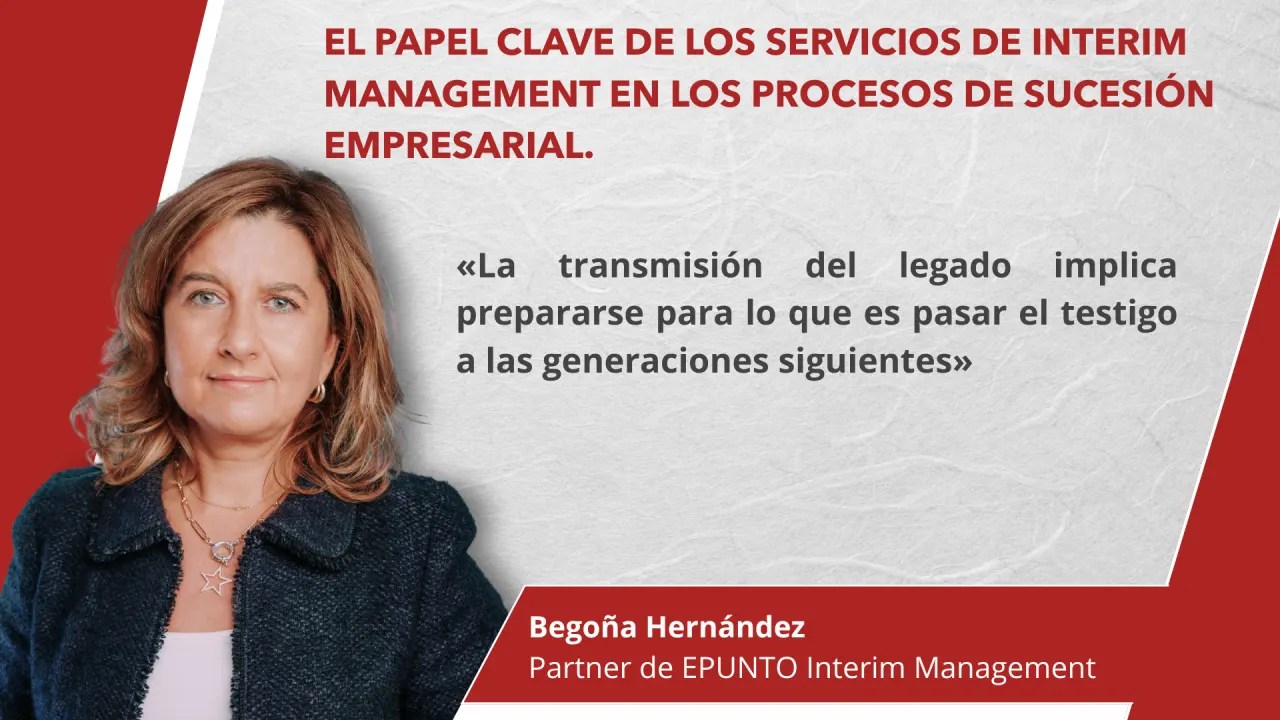
The interim manager as a cornerstone of the succession plan in family businesses and SMEs
The interim manager as a cornerstone of succession planning in family businesses and SMEs Management succession, particularly in family businesses and SMEs, requires an approach characterised by respect for the legacy and rigour in execution. For this reason, the interim manager plays an essential role as a facilitator who contributes […]
Management succession, particularly in family businesses and SMEs, demands an approach characterised by respect for the legacy and rigour in execution. For this reason, the interim manager plays an essential role as a facilitator who brings calm, experience and a clear methodology to ensure that each phase of the handover is carried out in an orderly and responsible manner.
Calm and experience from day one
“As well as bringing calm and experience, the interim manager stands out for their rigour at every stage of the handover,” emphasises Begoña Hernández, a partner at EPUNTO Interim Management. The presence of a senior professional reduces the pressure on the family or the outgoing management and enables decisions to be made with quantifiable results. Thanks to the interim manager’s accumulated experience, they act as a stabilising force by being able to prioritise critical issues, avoid improvisation and provide interim leadership that the internal team recognises as temporary yet decisive.
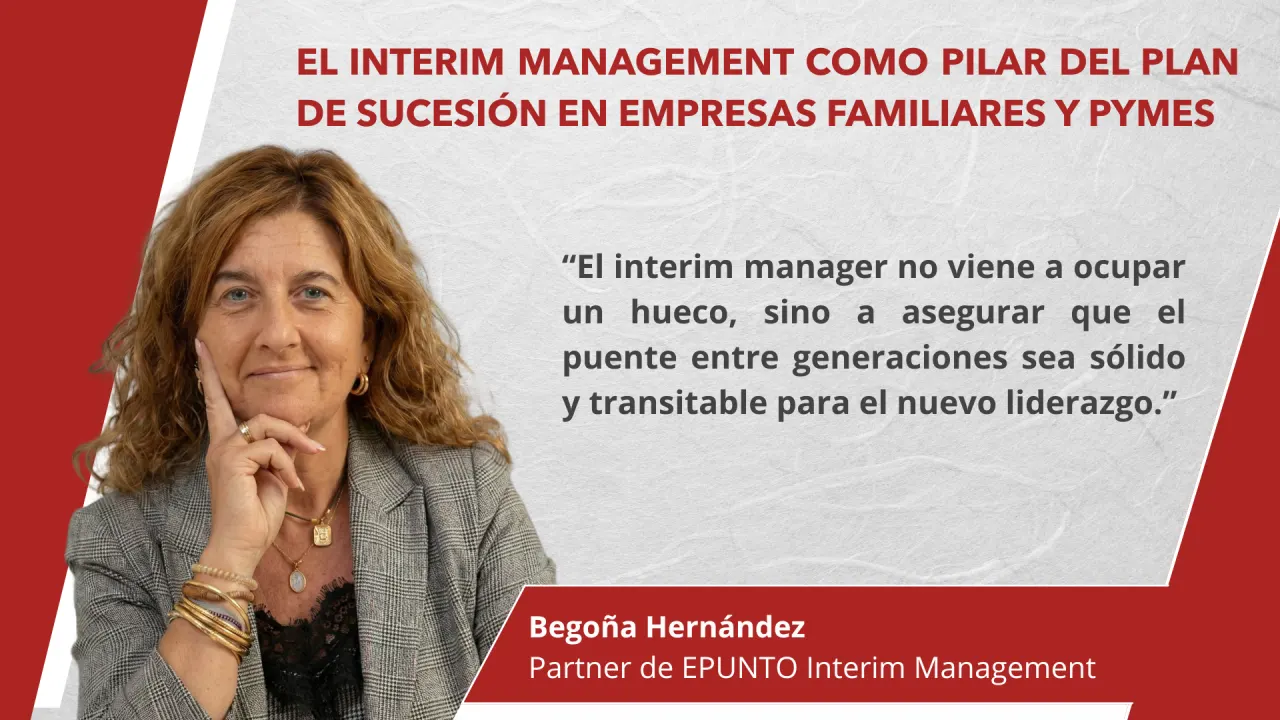
“The interim manager does not come in merely to fill a gap, but to ensure that the bridge between generations is solid and passable for the new leadership.”
Begoña Hernández Tweet
This control over operations translates into greater confidence among stakeholders (employees, customers and suppliers) and more orderly communication with financial institutions and regulatory bodies; these are key elements in ensuring that the succession does not affect business continuity.
How does one achieve an orderly transition based on stability?
Developing an orderly transition requires shielding the company’s operations from the uncertainty inherent in change. “The key lies in maintaining business stability whilst implementing the strategic moves involved in the handover,” notes Begoña Hernández. The interim manager leads this process by ensuring that day-to-day operations are not disrupted, managing timelines prudently and avoiding hasty decisions that could cause unease amongst staff or in the market.
With this focus on stability, the transition proceeds in a measured manner, allowing the successor’s adaptation and the organisation’s response to be assessed in real time. This rigorous oversight of each phase prevents power vacuums from arising and ensures that the handover of responsibilities takes place on a firm footing, thereby safeguarding the value and reputation of the family business throughout the process.
Mentoring and skills transfer
One of the interim manager’s most valuable contributions is, without doubt, the transfer of knowledge and mentoring to the successor. In companies where expertise is closely tied to specific individuals, the interim manager designs support programmes that combine technical training, exposure to decision-making and progressively greater responsibilities. This approach shortens learning curves and leaves behind documented procedures that endure beyond the end of the interim manager’s assignment.
Furthermore, the external figure can mediate in complex family dynamics, offer objective feedback and establish guidelines for coexistence between ownership and professional management – elements that facilitate professionalisation without severing emotional ties.
Governance, neutrality and risk management
The neutrality of the interim manager is useful for setting up governing bodies or strengthening existing ones: the Board of Directors, audit committees or transition committees. These structures enable decisions to be institutionalised and responsibilities to be separated.
In SMEs and family-owned businesses, where resistance to change may be high, the involvement of an interim manager lends credibility and facilitates the adoption of measures that would otherwise be perceived as contentious.
Results: continuity, legacy and the future
At the end of the process, the aim is not to replace the legacy, but to preserve it through professional and sustainable decisions.
EPUNTO has a portfolio of specialised profiles to support succession planning in family businesses and SMEs, combining sector-specific expertise, the ability to take charge immediately and a focus on skills transfer.
BEGOÑA HERNANDEZ, partner at EPUNTO Interim Management, a Valtus Alliance member