
Artificial intelligence does not replace the CFO: it transforms their ability to create value
AI is transforming the finance function, but its potential lies not in automating processes but in anticipating scenarios. Begoña Hernández explains why managerial judgement continues to make all the difference.
Artificial intelligence is transforming the finance function, but its true potential lies not solely in automating processes or improving efficiency. Its main contribution lies in its ability to anticipate scenarios, manage risks and improve companies’ strategic decisions.
Artificial intelligence is already a reality in finance departments, but it is worth reflecting on the fact that incorporating technology and generating value are two distinct challenges. The real challenge is not simply having more tools at our disposal, but integrating them effectively into management and turning their capabilities into better business decisions.
From explaining the past to anticipating the future
Traditionally, finance departments have devoted much of their efforts to analysing what has happened: financial closings, budget variances, cost trends or monitoring results. AI offers the opportunity to evolve towards a more predictive role, capable of anticipating trends, evaluating scenarios and identifying risks.
For example, by combining information on receivables, payables, customer behaviour and business performance, it is possible to improve cash flow forecasts, identify liquidity pressures and evaluate financing alternatives before problems arise.
Its application is also relevant in investment assessment, working capital optimisation, profitability analysis and resource allocation. The move towards agent-based AI solutions, capable of performing specific tasks and coordinating processes with a certain degree of autonomy, expands these possibilities through the continuous monitoring of indicators and the early detection of deviations.
The real qualitative leap does not lie in having more information, but in transforming it into useful knowledge to anticipate and act.
Management judgement continues to make the difference
AI is accelerating the evolution of the chief financial officer from a role centred on financial controlling towards an increasingly strategic one. By reducing repetitive tasks and expanding analytical capabilities, it allows greater attention to be devoted to the decisions that determine the growth, profitability and sustainability of the business.
But processing information is not the same as knowing how to make decisions. Algorithms can identify patterns, simulate scenarios and propose alternatives; however, determining which are viable, which risks are acceptable and which decisions best align with business strategy remains the responsibility of senior management.
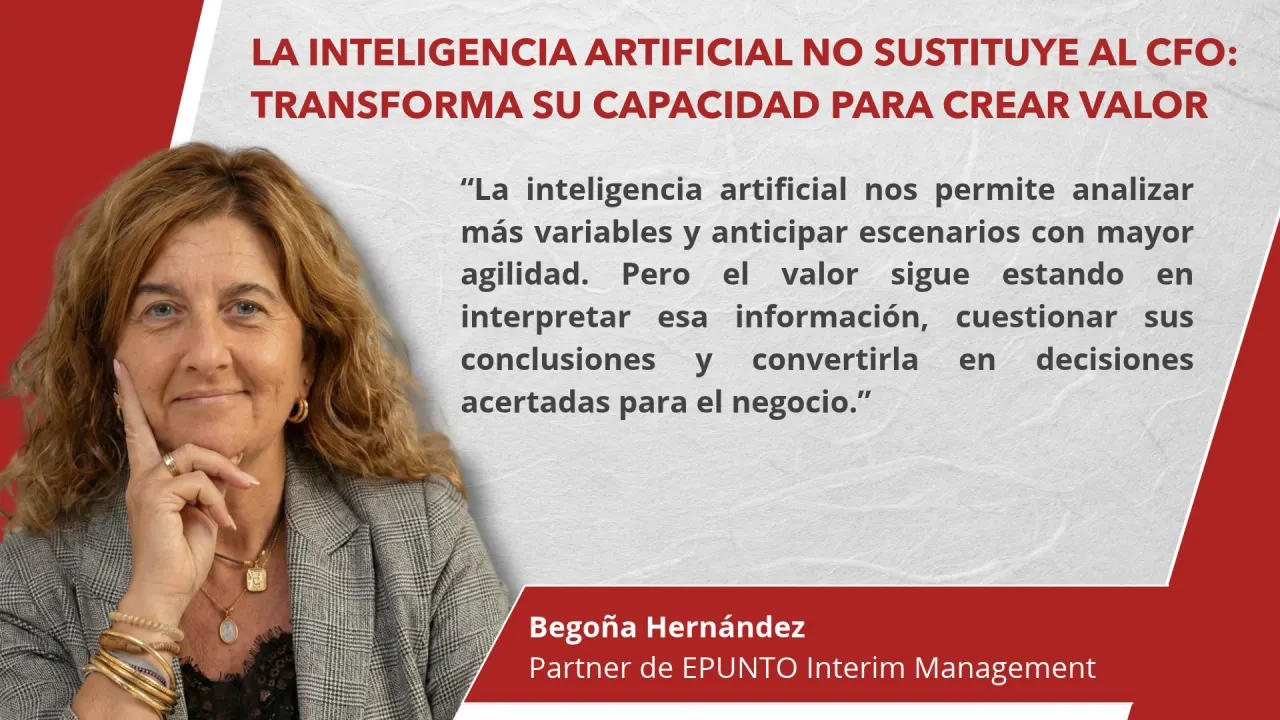
As Begoña Hernández, a partner at EPUNTO Interim Management, points out: “Artificial intelligence allows us to analyse more variables and anticipate scenarios with greater agility. But the value still lies in interpreting that information, questioning its conclusions and turning it into sound business decisions.”
This transformation is also redefining the skills required of finance teams. Accounting and technical knowledge must be complemented by business acumen, analytical skills and critical thinking. The aim is not simply to do the same with fewer resources, but to build a finance function that delivers greater value to the organisation.
For medium-sized companies, moreover, these technologies represent an opportunity to access advanced analytical capabilities previously reserved for large corporations. Technology democratises access to information and analysis, but it does not replace the experience or judgement required to make good decisions.
Technology is no substitute for sound financial organisation
Nor does artificial intelligence, on its own, resolve organisational weaknesses. A company with fragmented information, poorly defined processes or insufficient controls is unlikely to realise its full potential. It may even exacerbate existing problems if the source data lacks quality and reliability.
Therefore, any transformation must begin by identifying the business’s real needs, assessing the maturity of the finance function and prioritising initiatives with measurable results. Not all activities require AI, nor do all technological investments justify their cost.
Governance is equally essential: human oversight, traceability, data protection and validation of results must accompany the automation of financial processes.
AI multiplies the capabilities of a well-managed organisation, but it does not replace the fundamentals of rigorous financial management.
Leadership and expertise to turn technology into results
The integration of AI into the finance function is, above all, a process of business transformation. It requires leadership to set priorities, adapt processes, develop in-house capabilities and perform change management without compromising day-to-day operations.
In companies undergoing growth, reorganisation or professionalisation, interim management can play a particularly important role. The temporary appointment of an experienced finance director allows for the combination of day-to-day financial management with the driving of transformation initiatives, ensuring that technology meets specific needs and generates sustainable results.
At EPUNTO Interim Management, we support organisations through these processes by providing executives with hands-on management experience, capable of leading change, strengthening financial controlling and transferring knowledge to internal teams.
Artificial intelligence is changing the tools available to the finance director, but it is also raising expectations regarding their contribution to the business. The companies that generate the greatest value will not necessarily be those that adopt the most technology, but rather those that know how to combine it with sound financial management that is well-prepared and focused on making better decisions.