The Age of Liquid Talent: Why structural rigidity is the greatest risk facing Iberian businesses in 2026
Structural rigidity is a vulnerability in 2026. The era of ‘liquid talent’ promotes flexibility, performance-based remuneration and the use of artificial intelligence to boost corporate efficiency.
We are all aware of the abrupt change the business environment is already undergoing. What we considered the ideal standard for organising our companies just a few years ago may now become a hindrance. By 2026, the survival and growth of Iberian companies (yes, in Spain and Portugal) will no longer depend solely on the size of their workforce or the brand image they project, but on their actual agility.
This new paradigm does not only affect the senior management or the transition team, where we first saw this trend emerge. Today, this model permeates every specialised and ‘white-collar’ role. We are talking about data analysts, developers, engineers and consultants. We are moving full steam ahead into the era of liquid talent, and clinging to old, rigid structures is undoubtedly the greatest risk we can take today.
What exactly is liquid talent? Two-way adaptation
When we talk about liquid talent, we are going far beyond simple outsourcing or traditional freelance work. We are referring to an ecosystem of total flexibility based on perfect two-way adaptation. In other words, a model where both parties win.
On the one hand, companies gain access to the exact skills they need, at precisely the right moment and to the right extent. On the other, highly qualified professionals offer their services by aligning their periods of peak productivity with their own personal priorities. We no longer try to force a person into a forty-hour-a-week organisational structure; we now piece together talent and business needs like the pieces of a jigsaw puzzle. In this way, motivation and performance are always maintained at the highest level.
The end of boundaries
The mere act of sitting down to fill a post and sticking to a fixed timetable are concepts from a bygone era. The age of liquid talent is characterised by the blurring of spatial and temporal constraints. Work is no longer ‘a place you go to’, but ‘something you do’. As geographical barriers fall, Iberian companies can compete for (and with) the best specialists, regardless of whether they are working from Valladolid, Lisbon or Berlin. This delocalisation, combined with asynchronous working patterns in day-to-day operations, ensures that projects do not come to a standstill.
The new productivity paradigm: decoupling social security benefits
Perhaps one of the most profound shifts in mindset we are experiencing is how we understand the employment relationship and its costs. In the traditional model, the company bears a high cost due to absenteeism, downtime or the inevitable dips in employee productivity. However, in the liquid talent economy, these productivity losses disappear from the profit and loss account.
To achieve this, social security contributions must be decoupled from companies’ balance sheets. In this model, payment is made exclusively for the delivery of real value and the resolution of problems. Naturally, social security provisions and the safety net for workers remain sacrosanct and essential in our society, but they are pooled at a national level or through private organisations. By relieving the company of the financial burden of unproductive hours, the organisation multiplies its efficiency. And those resources saved can, at last, be channelled directly into innovation and growth.
Artificial intelligence: the time multiplier
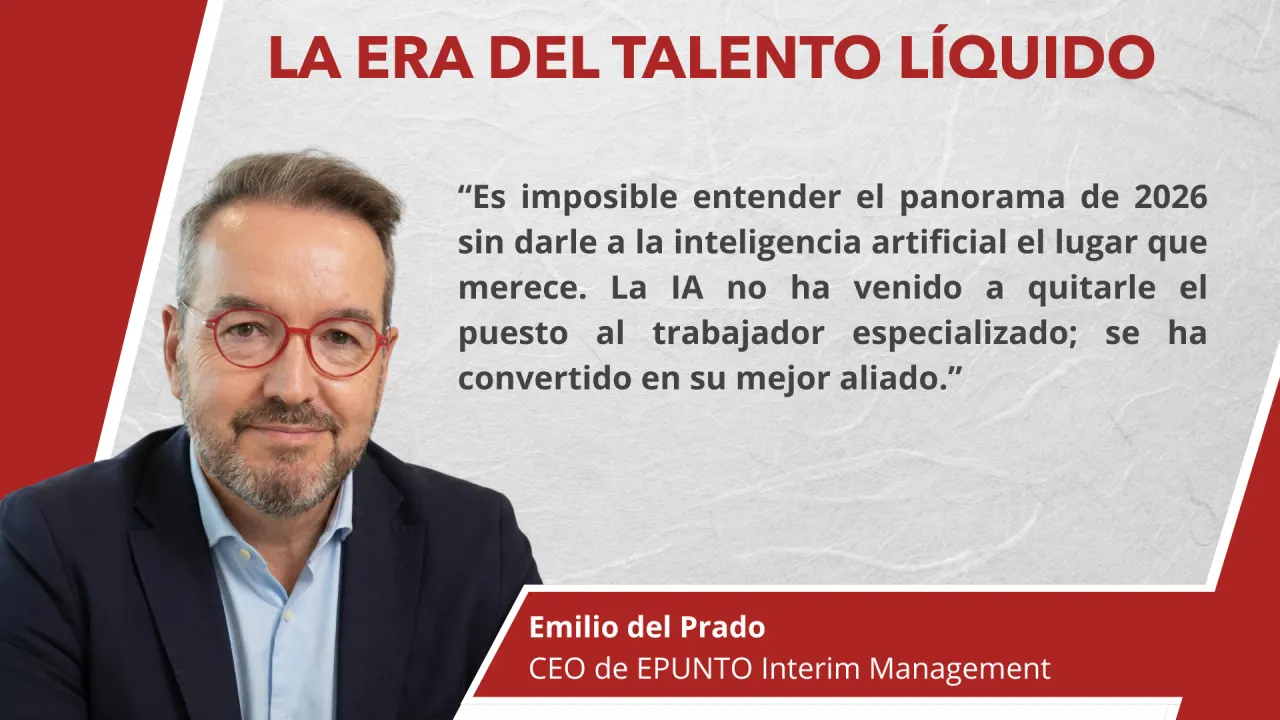
It is impossible to understand the landscape of 2026 without giving artificial intelligence the place it deserves. AI has not come to replace the skilled worker; it has become their greatest ally.
Therefore, in this fluid model, artificial intelligence acts as a time multiplier when it comes to producing deliverables and making decisions. A skilled professional, supported (always judiciously) by generative AI tools and predictive analytics, can conduct research, build software or design a strategy in a fraction of the time it would have taken just a couple of years ago. When this kind of talent is brought on board, it is not just a ‘brain’ that is added to the team, but also all the technological capability that comes with it.
From signing on to delivering value: Results-based remuneration
Finally, for liquid talent to truly work, the last barrier of the industrial era must be torn down: paying – exclusively – for time spent.
Currently, time is perhaps the worst possible metric for evaluating intellectual work. Companies that are already leading their sectors have drastically reduced their reliance on pay scales tied to hours worked. Now, everything revolves around performance-based incentives, milestones achieved and real value delivered. If a specialist, thanks to their experience and the use of AI, solves a critical problem in two days rather than two weeks, their remuneration should reflect the enormous impact of that solution, not the short time it took to achieve it.
What is the way forward?
Maintaining a rigid structure, bearing fixed costs that cannot be reduced, and failing to integrate on-demand talent are, today, the signs of greatest vulnerability for any business. At EPUNTO Interim Management, we have been leading this transition in executive roles for years, and we are now seeing first-hand how this mindset is now indispensable for any specialist professional.
Iberian companies have a historic opportunity before them: to inject ‘liquid talent’ into their corporate DNA and transform that old rigidity into the agility they need to excel in the market.