

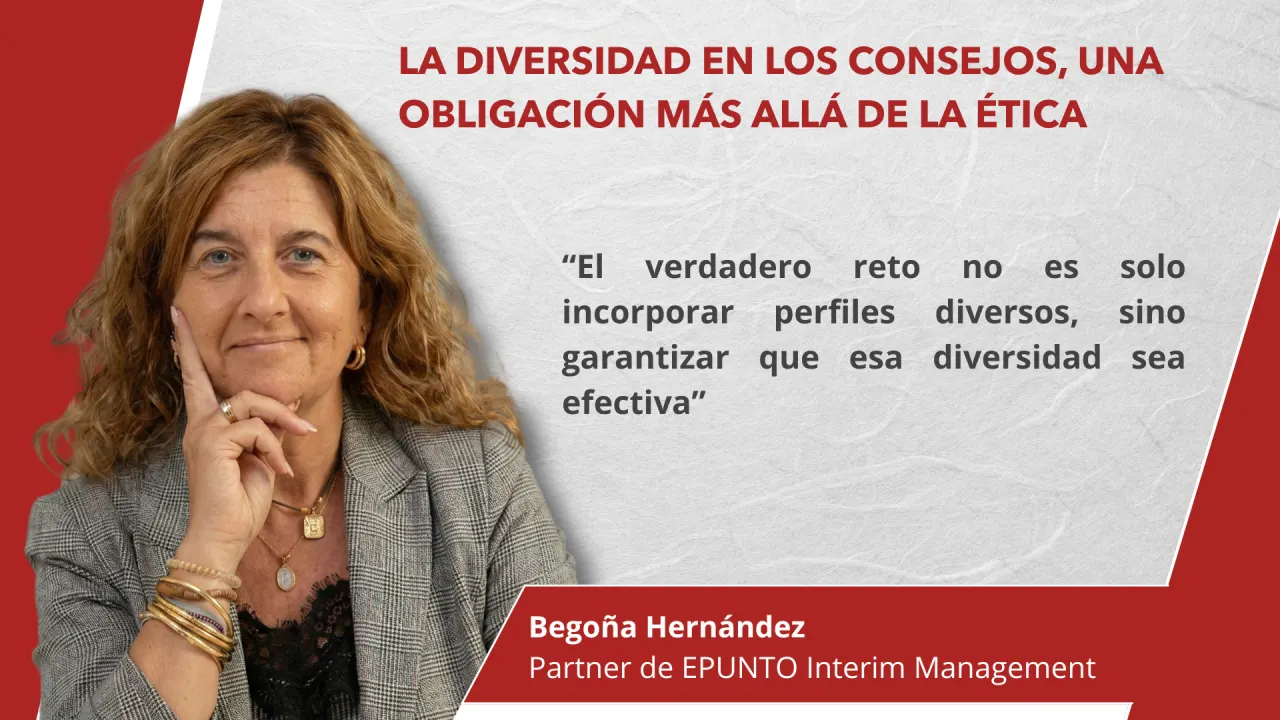
Diversity on boards: an obligation that goes beyond ethics
Diversity on Boards of Directors is no longer merely an ethical requirement but has become a survival strategy, helping to avoid cognitive biases and improve crisis management in complex situations.
For years, it has been common to talk about diversity on Boards of Directors as a matter of social responsibility or quota fulfilment. However, the reality of the market – characterised by increasing regulatory demands, pressure from institutional investors and the growing sophistication of risks – reveals something very different that is often overlooked: Diversity is, above all, a strategic decision linked to the company’s profitability and very survival.
Good corporate governance has evolved from a formalistic approach towards one focused on the actual effectiveness of the board of directors. Today, it is not enough simply to ‘comply’. It is essential to make the best decisions.
What does multidimensional diversity on Boards of Directors entail?
To achieve this, the board needs peripheral vision. And this broad perspective is impossible if everyone around the table shares the same background. We are no longer talking solely about gender, but about multidimensional diversity that includes professional experience, sector-specific knowledge, age, international background, technological skills and independence of judgement. On the contrary, a homogeneous board increases the risk of cognitive biases and may compromise its legal capacity to protect the company’s interests.
Why is diversity now a business priority?
Potential business risk factors have expanded dramatically (technological, reputational, regulatory, climate-related). In this environment, diversity shifts from being an abstract value to a concrete tool for protection.
As confirmed by various studies, including those carried out by Grant Thornton and McKinsey & Company, diverse boards manage crises more effectively because they avoid the dynamics of groupthink. These boards are able to identify emerging risks earlier, scrutinise strategic decisions more thoroughly and improve the quality of internal control, resulting in far more resilient organisations.
The strategic value of female talent
Within this diversity, the gender dimension has taken on particular significance. Recent European regulatory initiatives highlight a paradigm shift: the balanced representation of women is no longer merely a recommendation but is progressively becoming a legal and enforceable obligation.
But beyond compliance, there is another fundamental argument: the economic one. Women bring critical perspectives and leadership styles that enrich the debate. Ignoring this talent is not neutral; rather, it already represents a direct loss of competitiveness and capacity for innovation.
Reflecting the reality of the market
Companies operate in a diverse world and, therefore, it makes no sense for the body that takes the most important decisions to be out of touch with that diversity. A board capable of integrating different perspectives can make decisions (with the whole population in mind) that are more balanced, more in touch with reality and, ultimately, more sound.
“The real challenge is not just to bring in diverse profiles, but to ensure that this diversity is effective” — Begoña Hernández, partner at EPUNTO Interim Management
However, the real challenge is not merely to bring in diverse profiles, but to ensure that this diversity is effective. Fostering a culture of genuine debate, ensuring active participation and avoiding excessive concentrations of similar profiles is essential to prevent diversity from becoming a mere cosmetic exercise.
At EPUNTO Interim Management, we are fully aware of how the inclusion of diverse talent in governing bodies and management teams brings objectivity, accelerates strategic execution and facilitates organisational change processes.
Diversity on boards can no longer be treated as a voluntary commitment. Companies that understand this reality will be better prepared to compete in a complex environment; those that do not will be taking a risk that is difficult to justify.
Because today, more than ever, diversity is not just a matter of values. It is a matter of good governance.