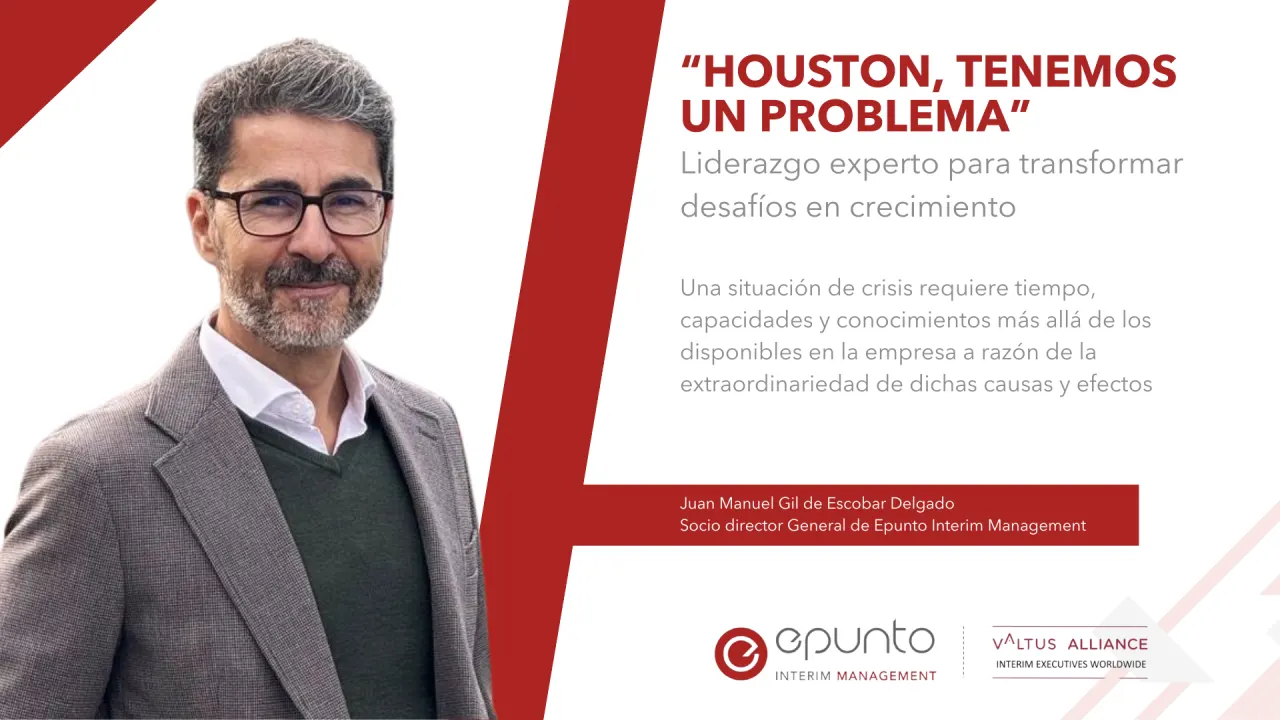
“HOUSTON, WE HAVE A PROBLEM”
HEADLINES: “Crisis management is increasingly establishing itself as a strategic area of expertise within the organisation” “A crisis situation requires time, skills and knowledge beyond those available within the organisation, given the extraordinary nature of its causes and effects” “Interim management offers a comprehensive solution to […]
HEADLINES:
“Crisis management is increasingly becoming a strategic area of expertise within the organisation”
“A crisis situation requires time, skills and knowledge beyond those available within the organisation, given the extraordinary nature of its causes and effects”
“Interim management offers a comprehensive solution to crisis situations across their entire spectrum and every possible combination of circumstances”
“Interim management helps to establish crisis management on a solid footing as a strategic area of expertise within the organisation, enhancing its know-how, competitiveness and market value”
Crisis management as a strategic area of expertise within the company
In this exponentially fast-paced world, companies are increasingly and exceptionally frequently faced with situations which, within the economic and social context, we have come to associate with the concept of a crisis.
This is accelerated by new technologies, artificial intelligence, the globalised market and geopolitical shifts, frequent changes in legislation and regulations, and awareness of climate change and corporate social responsibility, amongst other factors.
In this context, we could define a business crisis as any situation that has a significant and negative impact – whether in terms of the event itself or the risk of it occurring – on the management of day-to-day operations, competitiveness, profitability, viability, regulatory compliance, brand reputation or even the continuity of the business.
Given the seriousness of the areas affected, management convenes contingency meetings and emergency task forces; and, where the matter is of greater significance, we establish crisis committees for this purpose.
On every occasion, to a greater or lesser extent, we have to divert staff resources and time to deal with them, optionally allocating new resources and developing ad hoc procedures for this purpose – both formal and informal – with the obvious disruption to normal, day-to-day operations.
And if, unfortunately, such situations occur with increasing frequency, leading to a standardised approach to dealing with them, this is why crisis management tends to establish itself as a necessary and strategic area of expertise within the company, forming part of its management and leadership know-how, and even providing a distinctive value that can be recognised by the market and investors.
Uncertainty is known, and risk is manageable
There is a well-known saying that ‘reality is stubborn’, just as problems often are, in the sense that we can tackle them but cannot comfortably and reliably control their causes and effects.
A crisis situation requires time, skills and knowledge beyond those available within the company, given the extraordinary nature of these causes and effects. Even in such a case, however well-established and systematised our crisis management process may be, we may have no alternative but to pick up the phone and say, ‘Houston, we have a problem’.
Uncertainty is a known factor, in the sense that a conflict situation can and will certainly occur during the company’s lifetime, several times and with varying intensity and impact, although what we do not know is either when or to what extent.
On the other hand, the risk is manageable, because once we are aware of its existence, with simple foresight and planning, the solution becomes swift and highly effective. In other words, it boils down to an ‘if-else’ scenario based on asking a simple question: Do I have the necessary capacity and knowledge within the company to deal with this extraordinary situation?
If I do, then I set my tried-and-tested process in motion.
If I do not, then I make sure I have the Ground Control emergency telephone number to hand.
Restructuring vs chaos
The Interim Manager is particularly well-qualified for this: to bring order out of chaos. They are on the other end of that emergency telephone line.
Based on the manager’s ability to adapt to the company’s working practices, their experience in managing resources, assets and people, and their leadership skills honed over many years of dedication and in identical and similar situations, they naturally and unequivocally assume this key position within the company when faced with an extraordinary and sudden crisis.
In contributing specific skills and knowledge, as well as making up for the unavailability of the company’s own resources.
In situational awareness, in the efficiency of contingent executive action, in advisory support to the organisation’s structure, in the improvement of the company’s internal crisis management processes and procedures – in short, through direct executive action to resolve the issue.
Viability, competitiveness and value
A crisis takes on a meaning akin to the quantum cat of the Austrian physicist Schrödinger, which is both alive and dead at the same time; it exists and does not exist. In other words, although it could be assessed by quantifying the figures, it always contains a subjective aspect that gives it a debatable character – ranging from mild to severe, from structural to cyclical, urgent or significant, operational or existential – depending on the perspective from which we view it and the moment in time.
Supertramp’s famous album from the 1970s says it all: ‘Crisis? What crisis?’
But at a macro level there is no doubt: Interim Management offers a comprehensive solution to every possible combination of circumstances—both objective and subjective—across its entire broad spectrum, adapting to the situation, from serious cases such as the turnaround of a subsidiary to less extreme cases such as the internal restructuring of a production division that affects the company’s competitiveness in the market.
And beyond its primary executive role, interim management helps to establish crisis management on a solid footing as a strategic area of expertise within the company, thereby increasing its know-how, competitiveness and market value.