Interim management 2027: From crisis management to a sustainable growth strategy
The market has transformed the role of the interim manager. Far from being merely a ‘firefighter’, the interim manager of 2027 is an indispensable driving force behind scalability, innovation and sustainable growth strategy.
Historically, interim management services have been associated with emergency situations. In the corporate world, these services were typically used as a ‘stopgap’ in the face of an executive’s sudden departure, severe corporate restructuring or a reputational crisis. However, the market has matured and corporate needs have evolved.
Today, on the cusp of a new economic and technological cycle, the perception of external talent is undergoing a radical shift. It is no longer a matter of survival; the aim is to progress and scale up.
The evolution of the ‘firefighter’ executive
For years, urgency has overshadowed the true potential of interim management, as companies turned to this service as a one-off remedy for specific problems, limiting the executive’s impact to short-term stabilisation.
The current trend, with an eye on 2027, paints a completely different picture, in which companies have realised that bringing in senior talent (with proven experience and an objective perspective) is one of the most powerful tools for driving corporate transformation.
2027: The era of execution and artificial intelligence
As we have mentioned on several occasions:
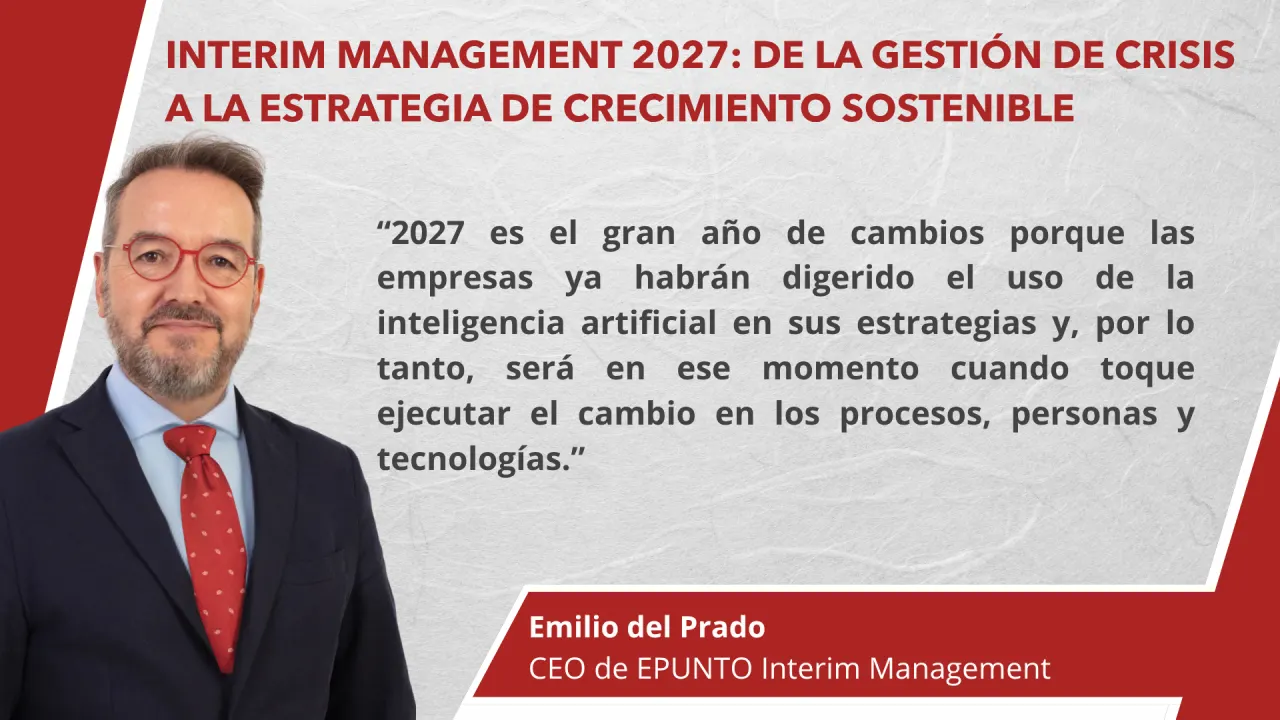
“2027 is the big year for change because companies will by then have fully embraced the use of artificial intelligence in their strategies, and it will therefore be at that point that the time comes to implement the change in processes, people and technologies”.
Navigating this phase of execution requires hyper-specialised leadership. Integrating artificial intelligence presents a profound challenge that has a direct impact on corporate culture and how day-to-day processes are managed. This is precisely where an interim manager can make a difference, spearheading the project with a clear roadmap, well-defined deadlines and a mindset entirely focused on delivering results.
The Interim Manager as a catalyst for lasting value
It is often believed that interim management leaves only a fleeting mark. However, the new approach to interim management seeks precisely the opposite: to establish a solid, structural legacy. The external manager acts as a catalyst for certain dynamics which, using only the usual internal resources, might take years to consolidate.
Currently, assignments driven by growth and transformation focus on key areas:
- Operational and technological innovation: Leadership in the implementation of complex systems or the redesign of supply chains to make them more resilient and efficient.
- Development of new markets: Leading internationalisation processes, mergers and acquisitions (M&A) or the launch of new business lines, drawing on previous experience of having done so successfully in other organisations.
- Change management and generational succession: Professionalising structures within family-owned businesses or facilitating the transition to new governance models, ensuring business continuity.
Towards a sustainable growth model
Bringing in executive talent on an on-demand basis enables organisations to make their operating structures more flexible (turning fixed costs into variable costs) whilst gaining access to top-level expertise exactly when they need it. This model ensures that strategic decisions are taken impartially, setting aside internal politics and prioritising the long-term sustainability of the business.
Far from being relegated to a mere stopgap to avert disasters, interim management in 2027 is emerging as the true driving force behind companies achieving extraordinary progress.