“True leadership does not require absolute control”
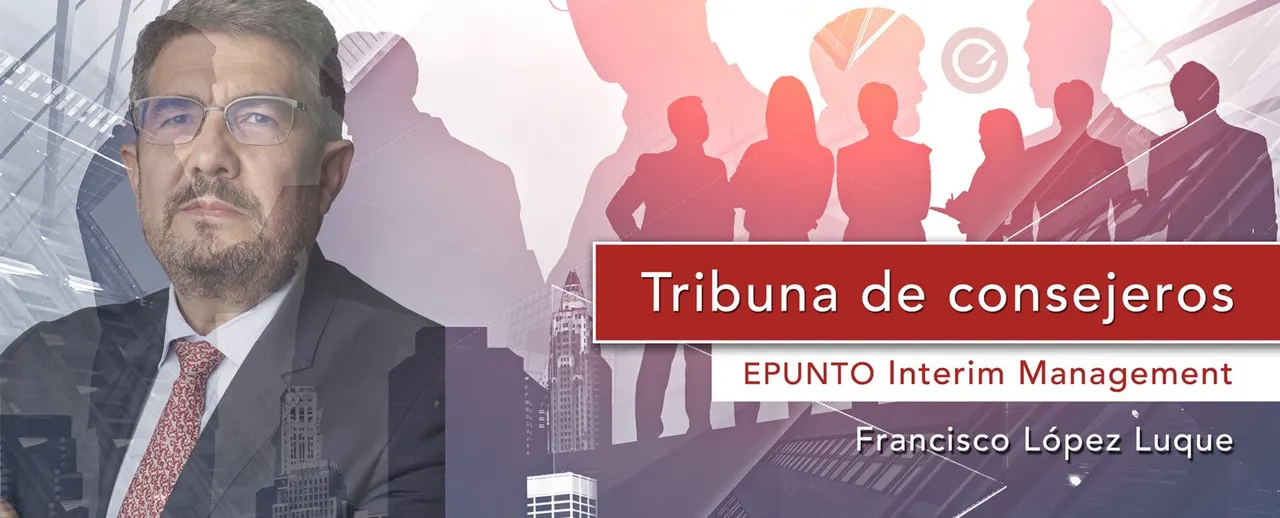
Francisco López, a member of the Advisory Board at EPUNTO Interim Management, is one of the leading professionals who has spearheaded technological innovation in Spain over the last 30 years. Drawing on his experience in multinational consultancy firms and high value-added technology companies, he reflects in this interview on the services […]
Francisco López, a member of the Advisory Board at EPUNTO Interim Management, is one of the leading professionals who has spearheaded technological innovation in Spain over the last 30 years. Drawing on his experience in multinational consultancy firms and high value-added technology companies, he reflects in this interview on the services provided by firms specialising in flexible management.
Madrid, 22 September 2021
It is a fact that innovation is a key factor in business competitiveness. In this regard, whilst interim management has been an established management practice in other European countries for decades, it represents an innovation in organisational management in our country; yet it has not quite taken off. Based on your knowledge and extensive experience as a manager, what is flexible management lacking or having too much of to become firmly established and grow in Spain?
As you say, innovation is a key factor in business competitiveness. Being an innovative company is not about having an innovation department, but about evolving the company’s culture towards innovation. This involves overcoming the tendency to maintain the ‘status quo’ and opening up to new ways of doing things. This is where interim management has to overcome certain barriers and demonstrate that, in certain circumstances, it can be the best option – though we mustn’t assume it’s the solution to all a company’s problems.
Spanish companies must accept that an executive does not need to be a permanent employee to achieve excellent results. The days of the full-time, office-based employee are long gone; true leadership does not require absolute control. Today’s teams are much more fluid, and we must be able to bring in talent in whatever form it takes. At the same time, for situations that may require temporary or specialised support, interim management is the solution that offers both security and flexibility.
EPUNTO Interim Management has taken a crucial step in its international expansion by joining the largest international network specialising in this field, Globalise, which has a presence across all five continents. Drawing on your experience as the founder and manager of a major multinational such as DMR Consulting (now Everis), and as a member of the EPUNTO I.M. Advisory Board, amongst other roles, what are the keys to success in international relations between companies with the potential to generate synergies and business opportunities?
My experience in international expansion tells me that this is a task that must be approached with a medium- to long-term perspective; opportunists may generate some business, but they cannot establish a stable operation. And, as in most cases, the suitability of the person you put in charge of the initiative is crucial. I am increasingly in favour of putting together a team with members who complement one another rather than appointing a single leader; I believe it is difficult for one person alone to provide everything needed for an international expansion. Intercultural skills are also very important. A good mix of expatriate and local managers usually guarantees success.
With its integration into Globalise, EPUNTO Interim Management offers its clients the opportunity to access local talent in the countries where they operate, whilst maintaining direct management of the relationship with the company providing the flexible management service – something that is essential in this management specialism.
Executive recruitment processes form part of the core business of most companies involved in interim management, such as EPUNTO Interim Management, which is applying state-of-the-art recruitment methodologies through its exclusive ‘Smart recruitment’© method, enabling any executive position to be filled in record time. What is your view on new technologies applied to talent management – specifically, to the selection of executives – such as artificial intelligence and machine learning, big data or augmented intelligence?
I believe these new technologies open up a whole new range of opportunities in the recruitment process, streamlining it and increasing the chances of success. In any case, whilst I value the recruitment process in its own right, I believe it plays only a relative role in a professional’s adaptation to a new company; I think values such as transparency and approachability have a greater impact. In short, technology will improve and should be utilised in what we might call ‘the mechanical part of the process’, but under no circumstances will it replace the human touch in recruitment processes.
Within Everis Initiatives, you were in charge of FiTalent, a corporate venture capital fund specialising in investments in the biotechnology sector. Indeed, one of the most common reasons for engaging interim management services is executive management following a merger or acquisition, in many cases driven by investment funds. What is your view on this? Is flexible leadership a high value-added service in M&A processes?
Clearly, if we look at the process of appointing executives at a start-up, we see that it is very amateurish. It is common to find the job description for the CEO listed as ‘CEO & Founder’, and from that description we can infer that the second part is a given – that person had the skills and determination to found a company. The first part of the description, however, is a different matter entirely. We often see that person taking on the role of CEO without possessing the minimum essential experience, training and skills. It is quite common for investors to demand a more “professional” appointment following the first rounds of funding. In such cases, as well as in mergers and, in particular, spin-offs of parts of companies, engaging an interim management firm is a highly recommended option. It can be a good way of assessing suitability or can serve to carry out functions that are specific to the M&A process itself.