

Senior talent in the longevity economy
Experience, knowledge, skills, maturity, resilience, a strong network of contacts and career paths rich in learning and experience – these are the valuable assets that senior talent is bringing to an increasingly ageing and active society. Madrid, 4 December 2024. Caught up in the technological whirlwind of this first quarter of the century […]
Experience, knowledge, skills, maturity, resilience, a strong network of contacts and career paths rich in learning and experience – these are the valuable assets that senior talent is bringing to an increasingly ageing and active society.
Madrid, 4 December 2024
Caught up in the technological whirlwind of this first quarter of the 21st century and immersed in the great digital transformation, Western societies are facing the challenge posed by the unchecked decline in birth rates and the ageing of the population. At the eye of this socio-cultural and economic storm are senior professionals of advanced age who are still fully capable of giving their very best. It is clear to those of us in the world of human resources and management that senior talent is becoming a key part of the workforce. In fact, it is essential for maintaining the productive fabric of any Western economy and the competitiveness of its businesses. To illustrate this reality, over the last decade, the proportion of the working population aged over fifty-five has increased by seven percentage points as a share of the total and now accounts for 15 per cent of all professionals actively seeking employment.
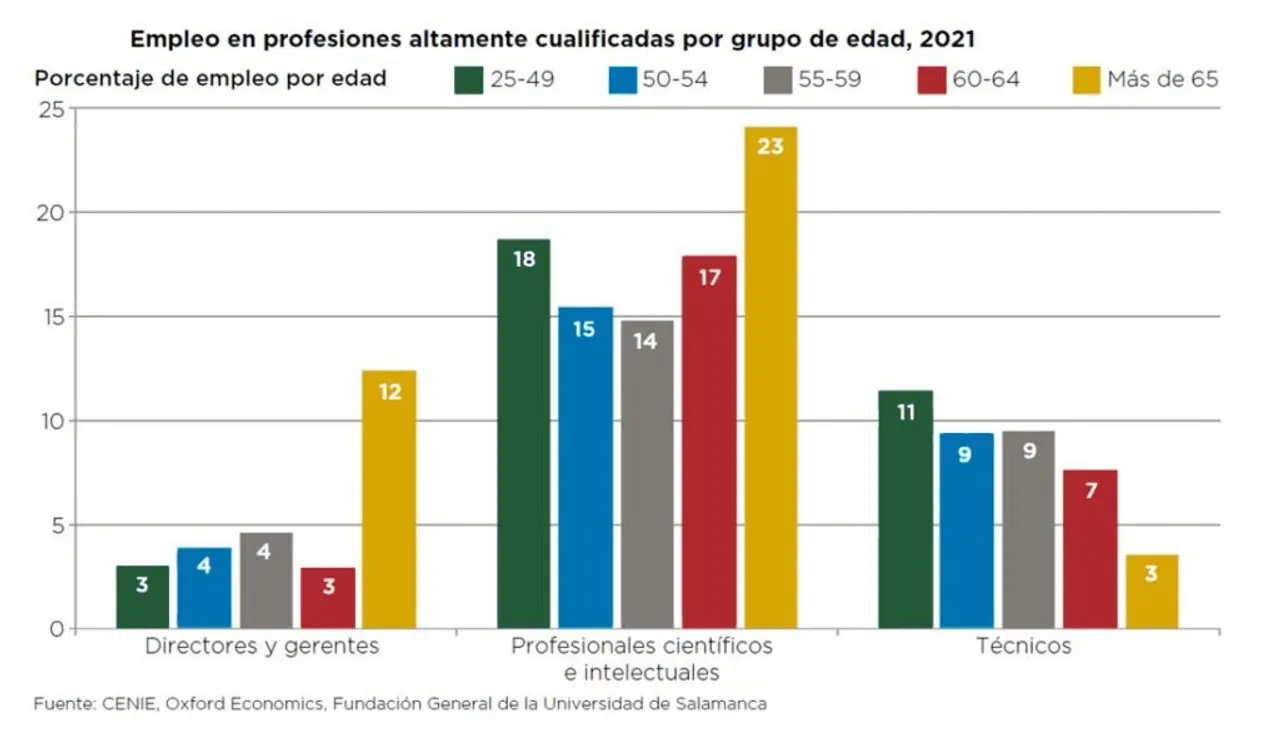
The Economic and Social Council of Castile and León and the General Foundation of the University of Salamanca have produced the study ‘The Economics of Longevity in Castile and León’, based on the report published in 2021 by Oxford Economics: ‘Investigating the Economics of Longevity in Spain’. According to this study, over the last 10 years the proportion of the population aged over 50 has risen from 39 per cent to 44 per cent, figures that are largely extrapolable to the rest of Spain. Other interesting findings from this study relate to the percentage of total employment by age group. Workers aged over 65 account for the largest proportion of directors and managers (12 per cent), as well as scientific and intellectual professionals (23 per cent), occupying the most highly skilled positions in the labour market. Among those aged between 55 and 59, 4 per cent of workers are listed as directors and managers, which is the next highest proportion.
In light of these figures and others emerging from the numerous studies carried out in recent years – such as the ‘White Paper on Senior Talent’ produced by the SERES and ADECO Foundations, amongst others – the time has come to view the daunting inverted population pyramid as an opportunity.
Beyond the world of work and senior management—led by executive interim management—social and economic projects are being developed in connection with the so-called ‘longevity economy’ and its many positive aspects. It is clear that increased longevity and improved health have a direct impact on rising consumption. And not only in the leisure sector – which particularly benefits all areas related to tourism – but across all sectors of the economy. Senior professionals, as a productive asset, represent a solid driver of growth for any country’s economy. It is essential that public sector managers take this situation very seriously and implement policies aimed at making the most of this situation, which is, by all accounts, irreversible. According to recent data from the International Centre on Ageing (CENIE), the population aged over 50 is forecast to exceed twenty-three million by 2050, which is equivalent to half the Spanish population.